

At 6439 Hollywood Boulevard, just steps from the long-vanished Warner Hollywood Theatre, stands a relic from a time when the boulevard was not yet defined by souvenir stands and passing crowds, but by elegant storefronts, glowing marquees, and a civic-minded sense that even the most ordinary object could be rendered with beauty and purpose. The William Stromberg Clock, installed around 1928, is one of the last surviving emblems of that era—a stately street clock that has silently observed Hollywood’s cycles of glamour, decline, and reinvention for almost a century.
By Allan R. Ellenberger

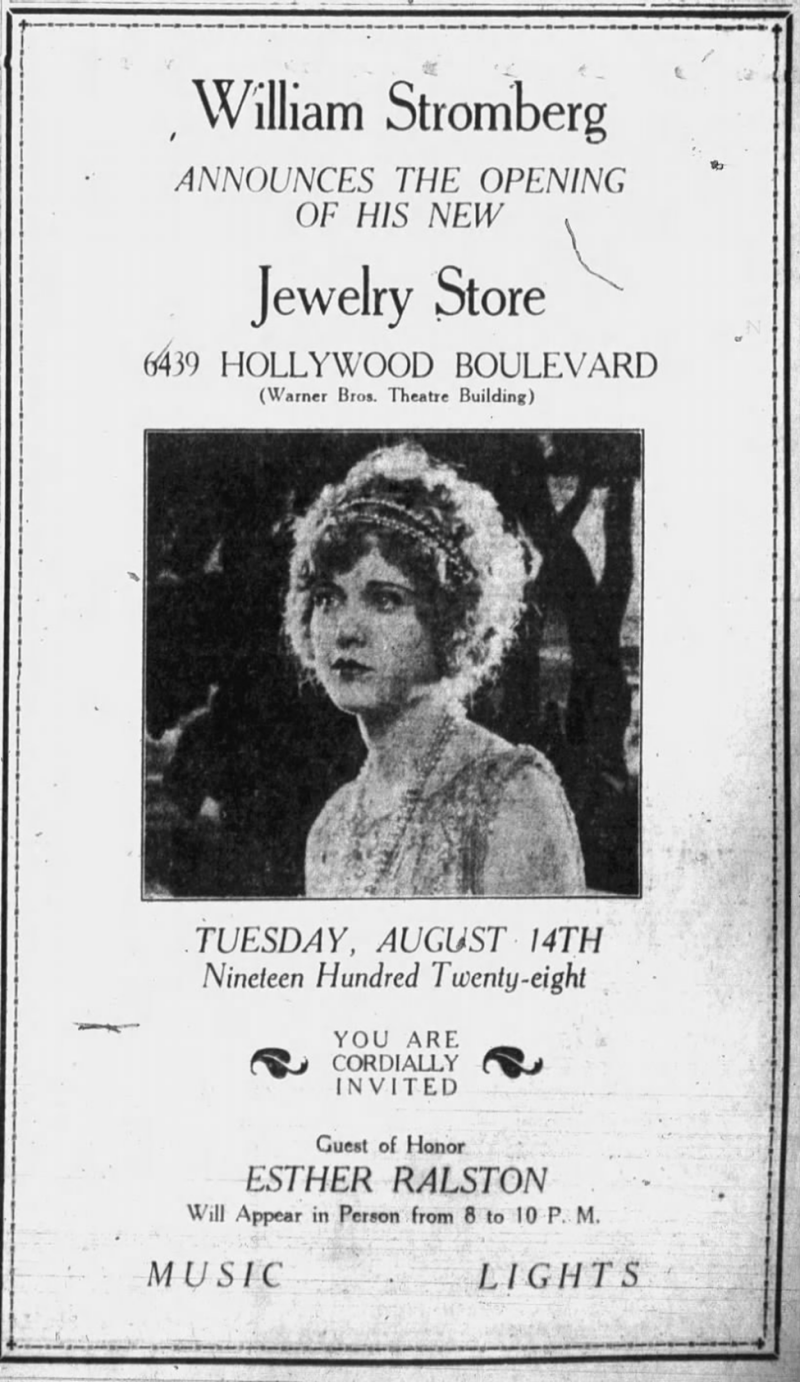
William Stromberg, a jeweler with an earlier era businessman's nose for retail display space, was responsible for the clock's creation. Stromberg's Hollywood Boulevard store opened on August 14, 1928, in the new Warner Bros. Theater. Actress Esther Ralston was guest of honor. Stromberg opened the store where shoppers were most likely to traverse on foot. Stromberg and his fellow jeweler merchants naturally appreciated the honesty of street clocks as advertising tools; their business was predicated on accuracy, trustworthiness and the romance of jewels. Clocks like Stromberg's were expected to be self-standing and deliberate.
Stromberg's commission followed suit. He wanted not just a sign, but a monument. He envisioned a large, stately clock that would catch the attention of passersby and anchor his store to the pulse of the boulevard. Mounted next to the Warner Hollywood Theatre—one of the largest movie palaces at the time—the clock began ticking, syncing Hollywood Boulevard to its minute hand.
Before the Walk of Fame allowed tourists to navigate the boulevard by celebrity names embedded in its sidewalks, pedestrians used storefronts like Stromberg's to measure distance, and the clock soon became a recognized place to meet.
The boulevard and clock have evolved over the decades. As Hollywood matured through the mid-century — its theaters growing older, its retail patterns shifting — changes were made to the clock to suit the era and its owners. Elements of its original 1928 appearance — simple, elegant proportions, detailed ornamentation — have been stripped away over time, with tweaks to its profile. Most of the clock that currently exists dates to the 1980s, when it was given its current ornamentation as part of a redesign. It is no longer entirely faithful to its 1920s predecessor, but it has not strayed far from the spirit of that boulevard: stately, rational and discreetly pedigreed.
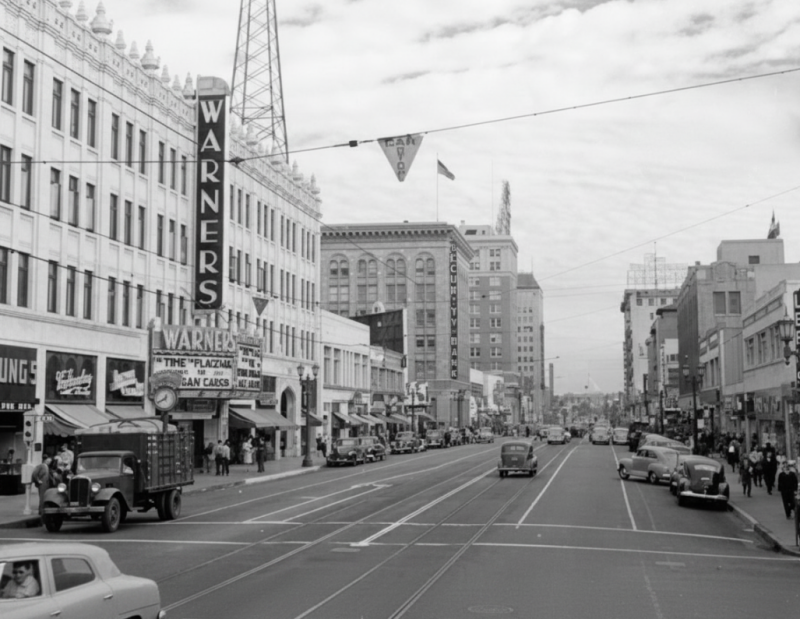
Hollywood Boulevard in 1946. The original Stromberg Clock can be seen on the left side above the delivery truck and under the Warner Bros. Theater marquee.
Its importance was recognized on January 7, 1987, when the City of Los Angeles declared the clock a Historic–Cultural Monument No. 316. This was due to both its age and uniqueness. Freestanding commercial clocks had become scarce sights along Los Angeles thoroughfares by the late twentieth century due to evolving city planning and retail trends. Only a few remain in existence today, and the Stromberg Clock is the only known clock still located on Hollywood Boulevard.
Time has not treated Stromberg's clock too well. Its gears stopped turning decades ago. Today, each of its faces displays a different time—the west face frozen at 8: 37; the east face forever stuck at 8:22. While motionless and unable to track time, the clock has become more symbolic than it ever could have been operating normally. You might say that it acts as a metaphor for film history in Hollywood: not one continuous narrative but rather a series of interruptions, breaks, and restarts.
And even in silence the clock takes part in the boulevard's cultural life. It has popped up in many movies throughout the years. Hollywood Boulevard was a convenient backdrop for just about any car chase sequence filmed during those days of cinema. The camera would whip through traffic and occasionally catch the angular shape of the clock. Decades later, it would get a starring role of sorts in the 1990 neo-noir film The Grifters. Filmmakers planted the clock prominently in the background as an homage to Hollywood's dark history.
The William Stromberg Clock lives on for reasons entirely unrelated to timekeeping. It's a reminder of what Hollywood Boulevard felt like in the golden era: sophisticated and grandiose. It reminds us that a jeweler once believed his business required such an extravagant show of time on public display--part advertisement, part civic pride. It memorializes a time when grand theatres were considered elegant architectural marvels; when store windows required spit shining before business hours, when attention to design--even on a humble street clock--meant something. More than that it stands as a testament to change. Time marches on Hollywood Boulevard whether its hands move or not, changing the character of this historic corridor forever. But never quite willing to erase its stylish past.

The redesigned Stromberg Clock as it appeared in recent years.
If the story of the William Stromberg Clock captured your imagination, please take a moment to comment, rate, and share this post to help preserve and celebrate Hollywood’s hidden history.
Add comment
Comments