

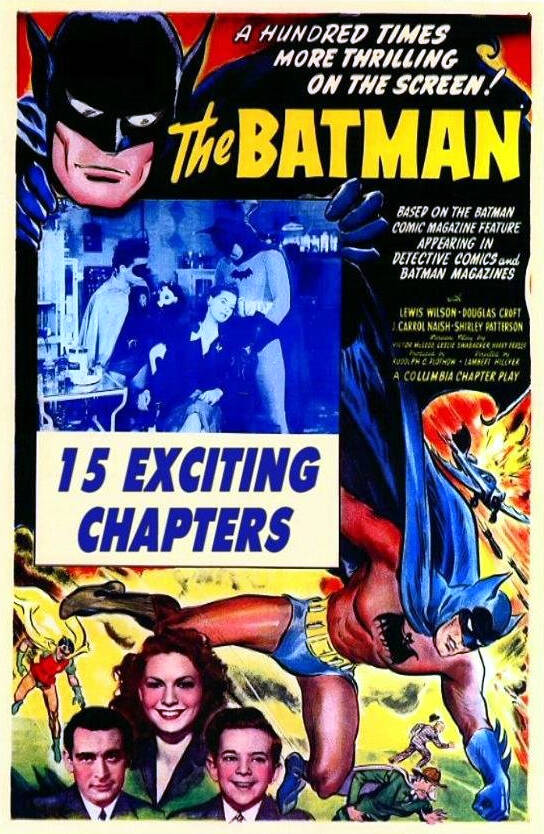
Before Batman became a television sensation, before Tim Burton restored his gothic grandeur, and long before the character became one of the most profitable properties in modern film history, he first stepped onto the screen in a wartime Columbia serial. Released in 1943, Batman was a 15-chapter cliffhanger starring Lewis Wilson as Batman and Bruce Wayne, with Douglas Croft as Robin and Dick Grayson. It was cheaply made, briskly paced, politically charged, and at times startlingly crude by modern standards, yet it remains historically indispensable: this was the first live-action appearance of Batman, Robin, Alfred, and several elements that would help shape the character’s screen mythology.
By Allan R. Ellenberger

The conception of the serial had occurred only four years after Batman first appeared in Detective Comics No. 27 in 1939. Columbia Pictures, with their history of turning out Saturday-matinee chapter plays, looked at the comic-book hero as a license to print money aimed at juveniles. Serials thrived on cliffhangers, masked identities, secret lairs, kidnappings, thrills, fights and last-minute escapes, and Batman fit into the format perfectly. The Serial was produced by Rudolph C. Flothow and directed by Lambert Hillyer, with the screenplay penned by Victor McLeod, Leslie Swabacker and Harry L. Fraser. Shooting was by James S. Brown Jr. and Lee Zahler composed the music.
The story transformed Batman and Robin into secret government agents operating in the wake of Pearl Harbor. Their enemy was not one of the now-familiar rogues from the comics, but an original villain, Dr. Tito Daka, a Japanese agent played by J. Carrol Naish. From his hidden headquarters beneath a sinister amusement attraction called the Cave of Horrors, Daka commands spies, sabotages American industry, and uses an “electrical brain” to turn victims into zombie-like servants.
Linda Page, Bruce Wayne’s girlfriend, played by Shirley Patterson, becomes entangled in the plot when her uncle is drawn into Daka’s schemes.
Seen today, the serial is impossible to separate from its wartime atmosphere. Its anti-Japanese propaganda is blatant and often ugly, reflecting the racism of American wartime popular culture after Pearl Harbor. Daka is presented through caricature, menace, and suspicion, and the dialogue contains language and attitudes that now land harshly. For a modern viewer, this material must be acknowledged honestly. It is part of the serial’s historical context, but it also marks the production as a troubling artifact of its time.
Lewis Wilson, only twenty-three when the serial was released, became the first actor ever to portray Batman on screen. Born Lewis Gilbert Wilson on January 28, 1920, in Framingham, Massachusetts, he had studied at Worcester Academy and trained as an actor before landing the role that would define his screen legacy. Batman was his screen debut, and although later critics mocked his somewhat soft physique, high voice, and Boston accent, Wilson remains historically important for establishing the first screen version of Bruce Wayne’s dual identity. After the war, he continued acting briefly, appeared in films such as Wild Women and Naked Alibi, then left show business and later worked for General Foods. He was also the father of Michael G. Wilson, later a major figure in the James Bond film franchise. Lewis Wilson died in San Francisco on August 9, 2000, at the age of eighty.
Douglas Croft was born Douglas Malcolm Wheatcroft in Seattle on August 12, 1926. He was sixteen years old when he played Robin, making him the first Boy Wonder to appear in live-action. Croft already had an impressive child actor resume that included Remember the Day, Kings Row, Yankee Doodle Dandy, The Pride of the Yankees, George Washington Slept Here, and Presenting Lily Mars.
Sadly, Croft's career fizzled after Batman. He only appeared in a handful of films after the Caped Crusader including River Gang and Killer McCoy. Croft died in Los Angeles on October 24, 1963, at age thirty-seven and was buried at Fort Rosecrans National Cemetery in San Diego.
Filming followed the economical, hard-driving methods of Columbia’s serial unit. The serial depended less on atmosphere than momentum: fistfights, secret doors, laboratory devices, car chases, disguises, cliffhangers, and narrow escapes. Its Batcave was modest but significant, helping establish the idea of Batman operating from a hidden underground headquarters. William Austin’s Alfred was originally comic and somewhat bumbling, but the screen version helped influence the later comic-book portrayal of the Wayne butler as slimmer and mustached, showing how even this low-budget serial fed back into Batman lore.

Lewis Wilson became the first actor to bring Batman to life on screen in Columbia Pictures’ 1943 serial Batman.

Douglas Croft made screen history as the first actor to portray Robin, Batman’s crime-fighting partner, in the 1943 Columbia serial Batman.
The costumes have become part of the serial’s strange charm. Wilson’s Batman outfit, based loosely on the early comic-book design, was baggy and awkward, with a cowl often criticized for its horn-like ears. Croft’s Robin costume likewise reflected a low-budget theatrical approach rather than comic-book sleekness. Later commentators have laughed at the doubles, the fight choreography, and the uneven physicality, but that very roughness places the serial firmly in the world of wartime matinee entertainment, where speed and suspense mattered more than polish.
The first chapter, “The Electrical Brain,” opened on July 16, 1943, followed weekly by chapters including “The Bat’s Cave,” “The Mark of the Zombies,” “Slaves of the Rising Sun,” “The Living Corpse,” “Poison Peril,” “Lured by Radium,” “The Sign of the Sphinx,” “Flying Spies,” and “A Nipponese Trap,” concluding with “The Doom of the Rising Sun.” In all, the serial ran roughly 260 minutes, a true Saturday-matinee commitment designed to lure young audiences back to the theater week after week.
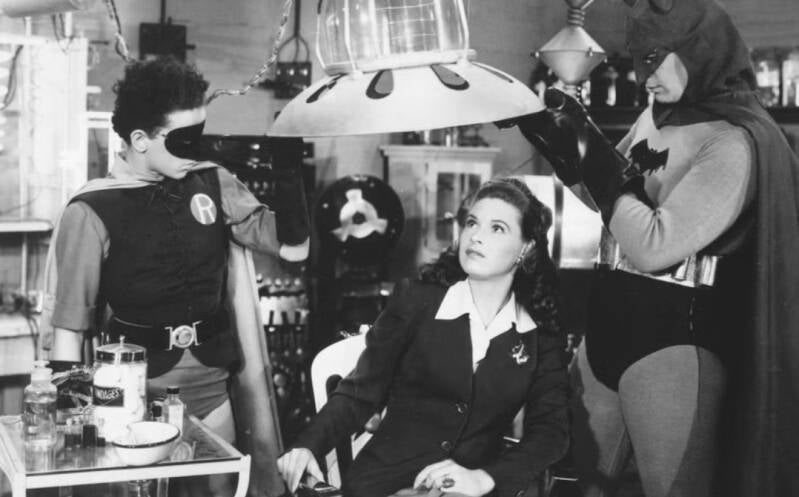
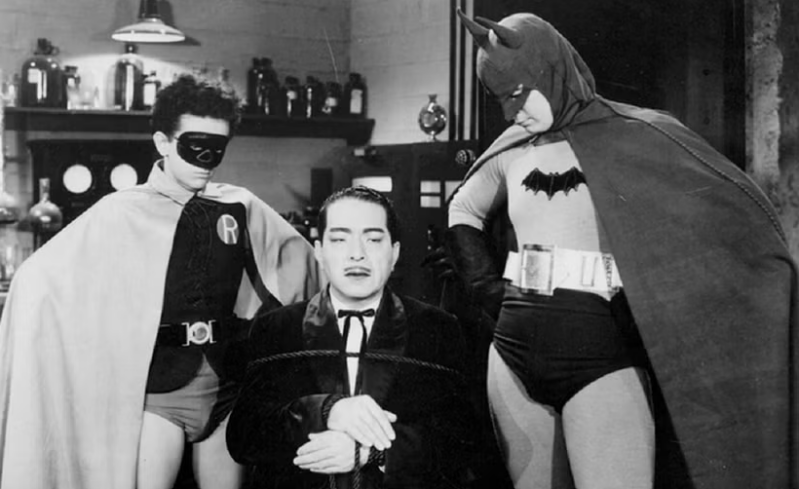
Contemporary trade response treated it largely as juvenile adventure. The Exhibitor rated it “good,” while Film Daily observed that the first chapter opened with energy and should satisfy youngsters, though older viewers might laugh at the wrong moments. Motion Picture Daily emphasized the fantastic comic-book action. The public response was strong enough to make it a commercial success, and Columbia later produced a second serial, Batman and Robin, in 1949, this time with Robert Lowery as Batman and Johnny Duncan as Robin.
The afterlife of the 1943 serial nearly rivals the importance of the serial itself. Columbia reissued it twice, in 1954 and again in 1962. Then in 1964 Hugh Hefner screened all fifteen chapters at the Playboy Mansion. Heffner’s showing contributed to a renewal of interest in the old serial. Columbia re-released it in 1965 as An Evening with Batman and Robin, often in marathon format. That exposure helped inspire what would become the 1966 Batman television series starring Adam West and Burt Ward. The camp tone of that show owed something to the rediscovered lunacy of the chapter play.
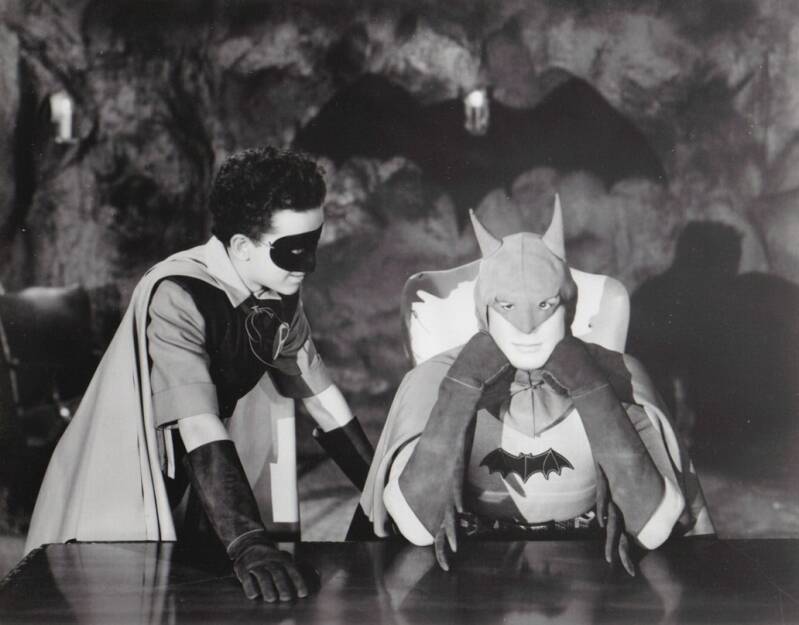
Batman is not a polished classic by most definitions. It’s too coarse, too propagandistic, too racially biased to be unconditionally embraced. But as a necessary classic, one that miraculously survived and remained culturally relevant, it’s indispensable. There is no other movie quite like it at the exact moment it was made: when did a comic-book vigilante ever before transition this way into motion pictures? Not as a mythic night creature, but as a Saturday matinee thrill-ride, streaking across movie screens confronting spies, zombies, and all manner of cliffhanger evil. Its importance lies not in perfection, but in origin. This is where Batman first left the printed page and entered the flickering dark of the movie theater.
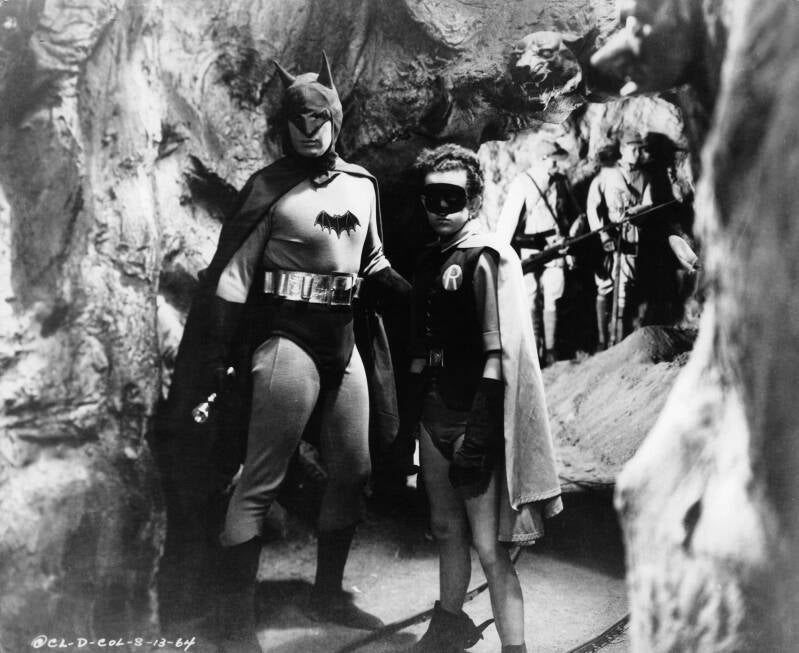
For all its flaws, Batman remains a fascinating relic: part comic-book adaptation, part wartime propaganda, part juvenile adventure, and part accidental blueprint for decades of screen mythology. The cape was wrinkled, the cowl was awkward, and the Batcave was modest, but the legend had arrived.
Tomorrow on The Hollywoodland Revue: the remarkable and often overlooked life of Beatrice DeMille, the brilliant playwright, actress, and mother whose influence helped shape one of Hollywood’s greatest dynasties.
If you enjoyed my look back at the 1943 Batman serial, please take a moment to comment on, rate, and share the post with fellow lovers of classic film and comic-book history.
Add comment
Comments