

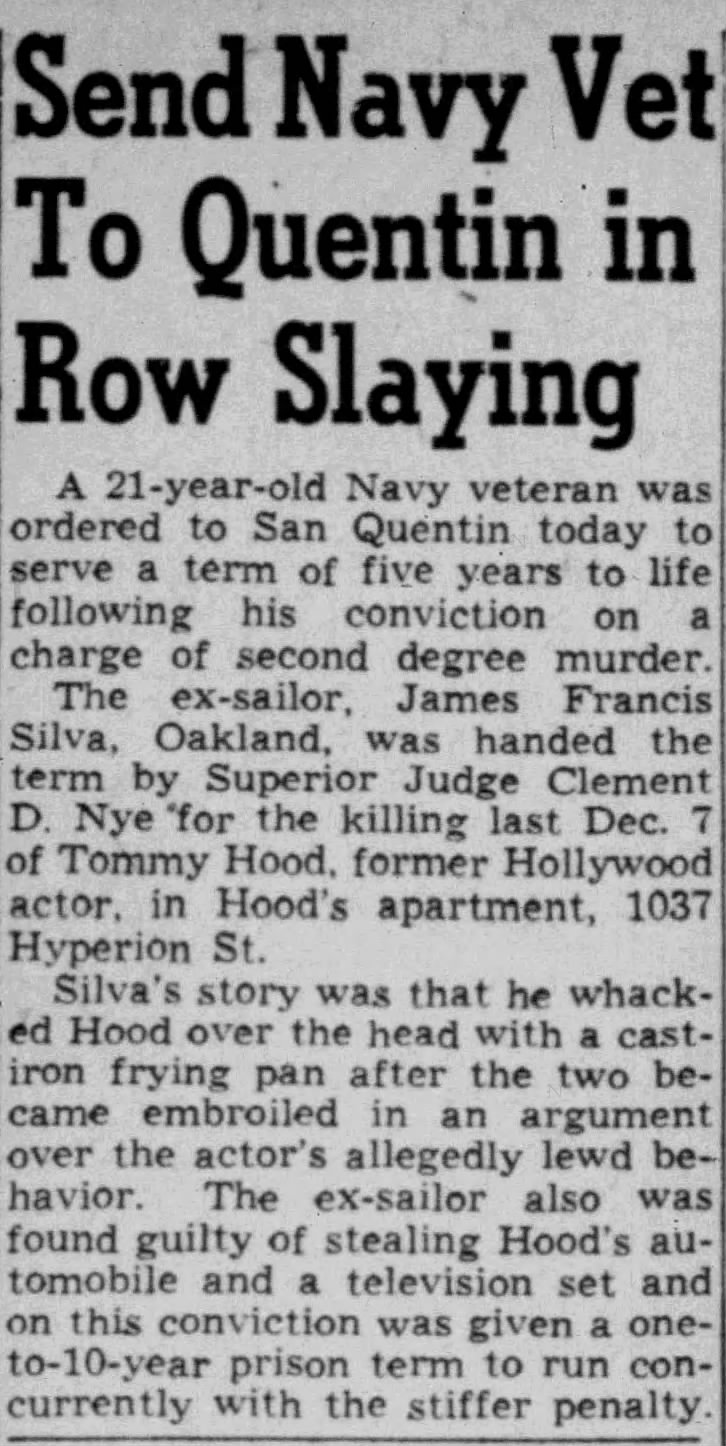
Initially convicted of second-degree murder of actor Tommy Hood, James Silva received a sentence of five years to life in prison. Yet his violent history did not end with Tommy Hood’s death. While incarcerated at San Quentin, Silva committed another shocking crime that once again thrust his name into California headlines. In 1953, he confessed to stabbing fellow inmate Kenneth King with a homemade knife after allegedly brooding over a perceived insult for weeks. Because California law at the time mandated the death penalty in certain repeat violent felony cases, Silva was condemned to die in the gas chamber.
By Allan R. Ellenberger

Facing the possibility of execution, he reportedly remarked that he may as well acknowledge the entire truth about Tommy Hood’s murder to the district attorney. In a chilling confession, Silva calmly described how he deliberately planned the attack and murder of Hood. “It was actually first degree,” Silva disturbingly declared. “I had planned it two weeks beforehand.”
He then described rising before dawn, quietly removing a frying pan from the kitchen, and creeping into the room where Hood was sleeping. “On the first good whack, he almost sat up in bed. That startled me,” Silva confessed, “but he fell back on the bed again, so I started smacking him with the pan. After 40 or 50 whacks, I stopped. I wiped the prints off the pan and put it back in the kitchen, came back in the bedroom and he was making some funny gurgling noise, so I picked up one of the pillows off the bed and put it over his face.”
Even more horrifying was Silva’s detached description of what followed. “I pressed down with both my hands to smother him,” he stated.
“I thought there was still life in him. I kept this up for five minutes. I guess this is what you wanted to know.”
The newspapers portrayed Silva as a man frighteningly devoid of remorse. Prison psychiatrists examined him almost immediately after the confession, while prosecutors described him as mentally twisted and dangerously violent. One district attorney publicly labeled Silva “a perverted and twisted mind.” Silva himself seemed bizarrely indifferent to his fate.
Yet even after his sentencing, the strange saga continued to grow darker and more bizarre. Governor Goodwin Knight and the California Supreme Court ultimately agreed that Silva’s death sentence should be commuted, and in March 1954 the punishment was reduced to life imprisonment without the possibility of parole. Remarkably, Silva himself opposed the decision. Rather than expressing relief, he repeatedly petitioned the courts to carry out his execution, insisting the state should allow him to die. The requests were denied.
California authorities, however, were not yet finished intervening on behalf of the convicted murderer. One report connected him to condemned murderess Barbara Graham — later immortalized in the film I Want to Live! — after prison officials disciplined Silva for allegedly whistling at the infamous inmate.
After serving a combined total of twenty years and six months for both the Tommy Hood killing and the San Quentin assault case, the California Adult Authority maneuvered around Silva’s supposedly permanent “no parole” sentence. In January 1971 officials recommended that his punishment be commuted on grounds that he had become stable, rehabilitated, and no longer dangerous. Later that year, in October 1971, the California Supreme Court agreed to commute the sentence.
When Silva quietly walked out of prison as a free man the following month, virtually nobody noticed. There were no screaming headlines, no outraged editorials, and almost no press coverage whatsoever. Outside the surviving members of Harold Sprankle’s family — the man Hollywood once knew as Tommy Hood — few people even remembered the crime anymore.

James Francis Silva shortly after his arrest for the murder of actor Tommy Hood, a crime that shocked Southern California and became one of the region's most widely publicized homicide cases.
Silva vanished almost immediately into obscurity, living the remainder of his life in near-total anonymity until his death in Yolo, California on June 9, 1998, at age sixty-seven. Tommy Hood’s murder thus became one more sensational Los Angeles crime story eventually swallowed by time, buried beneath newer scandals and forgotten tragedies. Yet behind the lurid newspaper coverage lay a far more revealing portrait of hidden Hollywood lives during an era when countless gay men existed under constant fear, secrecy, loneliness, and danger. Hood was never a major motion picture star, nor even a particularly successful actor, but his violent death exposed a concealed world that official Hollywood preferred not to acknowledge.

The final resting place of convicted murderer James Francis Silva at Woodland Cemetery in Woodland, California, where he is inurned in the Yolo section, Block B, Niche 44. (Photo Source: Findagrave/Michael Smuda).
In death, Tommy Hood became more famous than he had ever been in life. And somewhere beneath the glittering mythology of Hollywood’s golden age remains the memory of the slight, soft-spoken actor discovered hidden inside a folding bed on Hyperion Avenue — a grim reminder that behind the dream factory’s glamorous facade often existed desperation, isolation, violence, and tragedy.
Be sure to check back tomorrow on The Hollywoodland Revue for the fascinating story of Hollywood pioneer Dr. Edwin O. Palmer—physician, civic leader, historian, and one of the influential figures who helped shape the early growth and identity of Hollywood.
If you enjoyed Part Two of my investigation into James Francis Silva and the murder of actor Tommy Hood, please take a moment to comment on, rate, and share the article as we continue uncovering one of Hollywood's most tragic and forgotten crime stories.
Add comment
Comments