

Long before preservationists fought to save Hollywood’s vanished landmarks, before coffee-table books documented lost movie palaces, and before miniature artists became television curiosities, an extraordinary and almost forgotten exhibit attempted something astonishing: to preserve the entire spirit of Hollywood itself in miniature form. Streets, theaters, homes, hillsides, palm trees, neon signs, traffic lights, film studios, and even the rolling surf at Malibu Beach were painstakingly recreated by hand in one of the most ambitious model-city projects ever attempted in Southern California. Known as Hollywood in Miniature, the sprawling exhibit became both a technical marvel and an accidental time capsule of a vanished Los Angeles.
By Allan R. Ellenberger
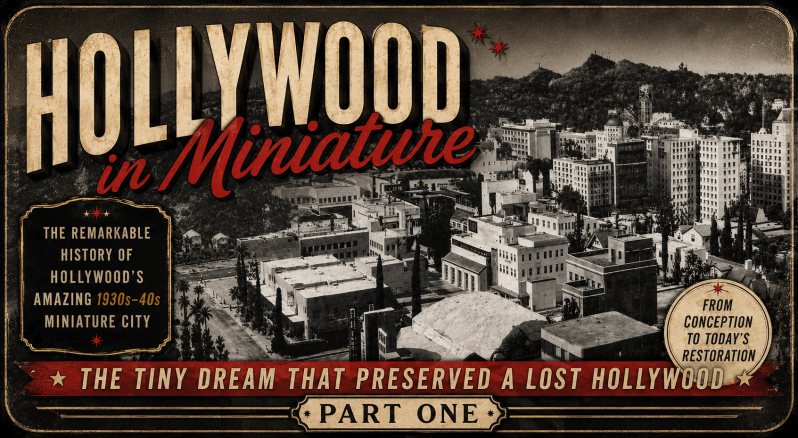
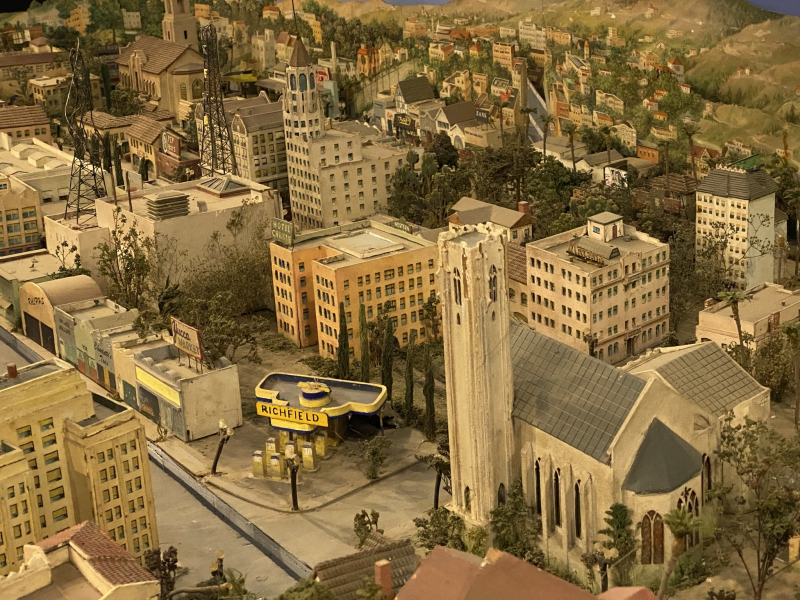
Today, portions of the surviving exhibit are once again on display in Hollywood, where the tiny city has come full circle. The remaining models are currently being restored and exhibited by Hollywood Heritage at its Preservation Resource Center at 6411 Hollywood Boulevard, allowing modern visitors to experience an astonishing three-dimensional recreation of 1930s and 1940s Los Angeles. More than simple miniatures, the structures now serve as preservation artifacts—fragile survivors from an era when Hollywood itself was still inventing its mythology.
The origins of the project stretched back to approximately 1937, when a small group of Hollywood artists, craftsmen, scenic designers, and technicians conceived the idea of building a fully realized scale model of the motion picture capital. The Depression had left many artisans struggling for work, but it also produced a generation of studio craftsmen capable of astonishing detail work. According to later accounts, the original creators envisioned the project not merely as entertainment but as a traveling exhibition that would allow people across America—many of whom would never visit California—to experience Hollywood in physical form.
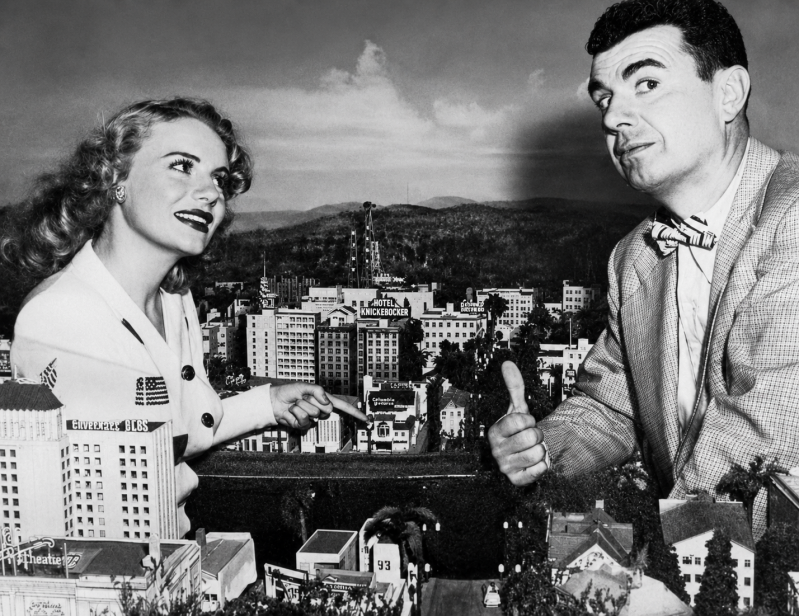
At the center of the undertaking was master woodworker and cabinetmaker Joe Pellkofer, whose name would eventually become inseparable from the exhibit itself. Though early stories often described the creator only vaguely—sometimes referring to an anonymous retired concert pianist and composer behind the financing and organization of the project—it was Pellkofer’s craftsmanship and obsessive attention to detail that gave the miniature city its extraordinary realism. Working in Pasadena studios and workshops, Pellkofer and a team of artisans devoted years to constructing the elaborate models entirely by hand.
By the mid-1940s the project had evolved into a massive undertaking. Reports described twenty-seven craftsmen laboring over the miniatures while using thousands of photographs, municipal maps, architectural drawings, and direct measurements to achieve astonishing accuracy. Forty blocks of Hollywood were eventually reproduced in minute detail. Buildings were constructed to a scale of approximately 1/32 of an inch to the foot, with every structure painted to match the original colors of the actual city.
The exhibit’s creators obsessed over realism. The famous Hollywood Bowl appeared complete with rows of tiny seats and the surrounding hills. Grauman’s Chinese Theatre was recreated down to its ornate Chinese carvings and forecourt details. The Brown Derby, Malibu Beach, residential neighborhoods, the Cahuenga Pass, and even the distant Griffith Park Observatory were included in the display. Streets were illuminated with functioning miniature streetlights while hundreds of tiny automobiles and trucks populated the roadways.
Promotional material from the period proudly advertised that visitors would see “450 buildings authentically reproduced, 10,000 trees, more than 900 lamp posts that actually light up, hundreds of street signs, autos, streetcars.” The brochure further promised audiences that the “brilliant lighting effects change to show you Hollywood under the noon sun, in the setting sun, at night under electric lights, under a full moon.” What sounded like carnival hyperbole was, remarkably, entirely true.
One of the exhibit’s most celebrated effects was its Malibu Beach sequence. Using hidden mechanisms and carefully synchronized engineering, miniature waves actually rolled onto the shore in rhythmic imitation of the Pacific surf.

According to contemporary interviews, the creator reportedly sat for days at the beach timing real waves with a stopwatch to reproduce the movement accurately. Publicity invited audiences to experience “Beautiful Malibu Beach” and “see that perfect stretch of crescent coastline,” complete with moving surf and the homes of movie stars overlooking the Pacific.
Another remarkable feature involved lighting effects that simulated the changing hours of the day. Audiences watched as the city shifted from bright daylight into glowing twilight and eventually into nighttime illumination, with neon signs flickering to life across the miniature boulevards. Mountains in the background changed color while the Hollywood Bowl appeared under performance lighting. These elaborate visual transitions required crews of operators and extensive electrical systems hidden beneath the exhibit.

The promotional brochures also emphasized that visitors could walk through a complete “Motion Picture Studio,” featuring “exact scale-model stages, casting offices, outdoor sets, cafes, dressing rooms—even a police and fire department.” Every detail was designed to make audiences feel they were stepping directly inside the hidden machinery of Hollywood itself.
By late 1945 the project was nearing completion. Pasadena and Los Angeles newspapers finally began revealing details of the mysterious undertaking. The Pasadena Independent described it as “Hollywood in Miniature,” while columnist accounts marveled that an entire version of Hollywood had been secretly built inside Pasadena workshops. The exhibit occupied approximately 1,500 square feet and represented an investment of over $250,000—a staggering sum for the era, equivalent to several million dollars today.
Return tomorrow to The Hollywoodland Revue for Part Two of “Hollywood in Miniature,” as the strange, intricate world of tiny movie palaces, celebrity dollhouses, and forgotten miniature wonders grows even more fascinating.
If you enjoyed this journey through the strange and enchanting world of Hollywood in Miniatures, please comment on, rate, and share the post with fellow lovers of classic Hollywood history and forgotten Los Angeles treasures.
Add comment
Comments