

The Hollywood in Miniature exhibit officially premiered in Hollywood in early 1946 under the sponsorship of the Hollywood Chamber of Commerce. Civic leaders promoted it as both entertainment and a celebration of the movie capital. Publicity described the attraction as one of the most remarkable exhibits ever shown in the city. Visitors praised the extraordinary craftsmanship and referred to it as “a dream come true” and “an artistic triumph.”
Hollywood celebrities themselves quickly endorsed the attraction. One promotional flyer declared that “Hollywood Stars Hail ‘Hollywood in Miniature’ With Greatest Praise.” Bob Hope reportedly quipped, “Here is where Hollywood out-colossals itself at last.” Robert Young called it “another tribute to the wizardry and patience of Hollywood artisans.” Alice Faye reportedly described it as “Magnifique!” while Joe E. Brown joked, “‘Hollywood in Miniature’ great? Brother, you said a mouthful.” Eddie Cantor enthusiastically proclaimed, “I’d love to spend a thousand hours with you, in Miniature,” and Cornel Wilde described the exhibit as “truly a remarkable exhibit and a display everyone should see.”
To transport the exhibit around the country, special custom-built trailers were constructed by Pasadena builder August Hahling. These elaborate transport units were themselves engineering marvels. Thirty-five feet long and equipped with electrical systems and expandable walls, the trailers transformed into exhibition halls once parked. Painted in lime green with chocolate lettering, they became moving advertisements for the attraction as it prepared for national touring.
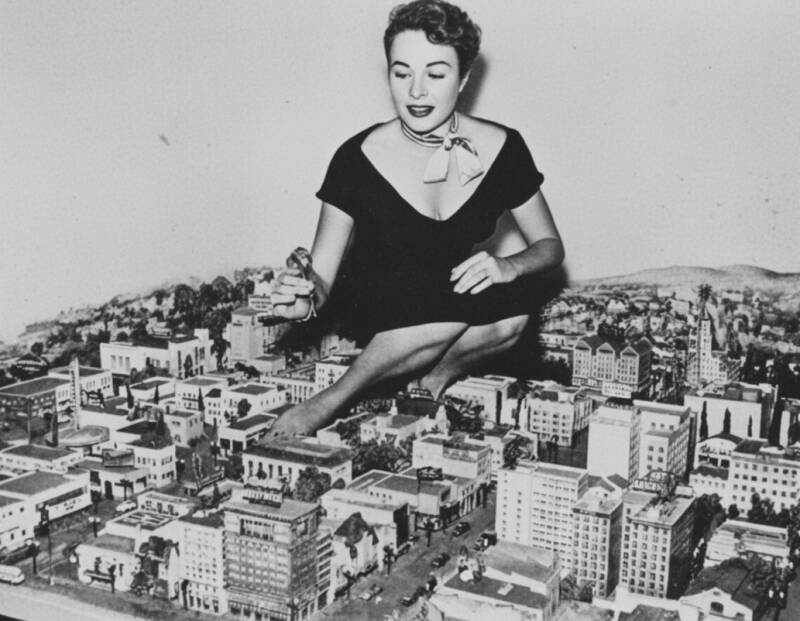
Dancer Marge Champion is perched on top of the Hollywood in Miniature display at the Home Show in Pan-Pacific Auditorium in 1951.
Following its Hollywood debut, Hollywood in Miniature traveled to New York and other American cities. Promoters believed audiences nationwide would eagerly pay to experience Hollywood up close, especially during the immediate postwar years when the glamour of the film industry was at its cultural peak. Authorities suggested plans for an eventual world tour, with hopes of sending the exhibit to Europe and beyond.
Yet despite the excitement surrounding the attraction, maintaining such a massive and delicate exhibition proved extraordinarily difficult. Transporting hundreds of fragile handcrafted buildings, lighting systems, moving mechanical effects, and scenic backdrops required constant repairs and maintenance. Over time the exhibit faded from national attention. Portions of the display were shown periodically at fairs, exhibitions, and home shows during the late 1940s and early 1950s, including an appearance at the Pan-Pacific Auditorium in Los Angeles in 1951, where the public once again marveled at its realism.
As Hollywood itself changed during the postwar decades, the exhibit unintentionally became a preserved memory of the city’s golden era. Buildings demolished in real life survived in miniature form. Entire streetscapes that vanished under redevelopment continued to exist inside storage crates and forgotten warehouses.
For decades the exhibit drifted into obscurity. Then, in one of the great preservation stories of Hollywood history, Joe Pellkofer himself emerged as the project’s unlikely savior. By the 1980s and early 1990s, much of the exhibit had deteriorated badly after decades in storage. Some pieces had been damaged or destroyed, while others sat neglected in barns and warehouses. Pellkofer spent years painstakingly restoring the models by hand. Working largely outside public attention, he repaired buildings, recreated missing details, restored lighting systems, and reconstructed portions of the cityscape.
His dedication transformed him into both preservationist and artist. In interviews, Pellkofer explained that he rebuilt Hollywood because “Hollywood is Hollywood in the ’40s.” To him, the exhibit represented not merely architecture but memory itself.

During the 1990s revival of the exhibit, people celebrated the restored miniatures as one of the most unusual preservation projects in Los Angeles history. In 1994, renewed public interest arrived when Hollywood Heritage founder Marian Ackerman rediscovered the surviving models and recognized their enormous historical value. Soon afterward, businessman Tom Hornberger and the Gibbons Entertainment Group became involved in efforts to restore and publicly display the attraction once more.

Joe Pelkofer stands beneath the glowing marquee of Miniatures of Hollywood, proudly unveiling his painstakingly restored creations in their new home in 1986.
The result was On Location in Hollywood, a revived version of the original exhibit installed inside the historic El Capitan Building at 6834 Hollywood Boulevard in 1986. Visitors once again wandered past tiny replicas of the Brown Derby, Grauman’s Chinese Theatre, Malibu mansions, studio backlots, and neon-lit boulevards frozen forever in the glamour of the 1940s.
The exhibit’s modern preservation era began in earnest in 2014 when Hollywood Heritage acquired the surviving miniatures and initiated a long-term expert restoration campaign. The nonprofit organization recognized that the eighty-year-old structures represented far more than nostalgic curiosities; they were historic artifacts documenting an entire vanished streetscape of Los Angeles. Since then, conservators and preservation specialists have worked carefully to stabilize, clean, repair, and restore the fragile models while preserving as much original material as possible.
Today, the restored sections are displayed at the Hollywood Heritage Preservation Resource Center at 6411 Hollywood Boulevard, where visitors can once again study the remarkable craftsmanship up close. The exhibit is frequently accompanied by public lectures and presentations from historians and conservation experts who discuss both the history of the attraction and the painstaking rehabilitation process behind its survival.
What began as a touring attraction designed to celebrate Hollywood glamour has evolved into something far more important: a surviving three-dimensional document of old Los Angeles. Many of the original buildings represented in miniature have long since vanished from the real city. Yet inside the exhibit, they remain frozen in time beneath tiny neon lights and painted skies.
In many ways, Hollywood in Miniature achieved something even historians and preservationists often struggle to accomplish. It captured not merely buildings, but atmosphere: the glow of neon on Hollywood Boulevard, the fantasy of Malibu at sunset, the dreamlike glamour of movie palaces, and the idealized vision of a city that existed as much in imagination as reality. Tiny though it was, Hollywood in Miniature preserved an entire world.
Tomorrow on The Hollywoodland Revue: discover the tragic and largely forgotten story of silent screen actress Minnie Provost, whose life and final resting place at Hollywood Forever Cemetery reveal another haunting chapter from Hollywood’s vanished past.
If you enjoyed this journey through the strange and enchanting world of Hollywood in Miniature, please comment on, rate, and share the post with fellow lovers of classic Hollywood history and forgotten Los Angeles treasures.

Add comment
Comments