

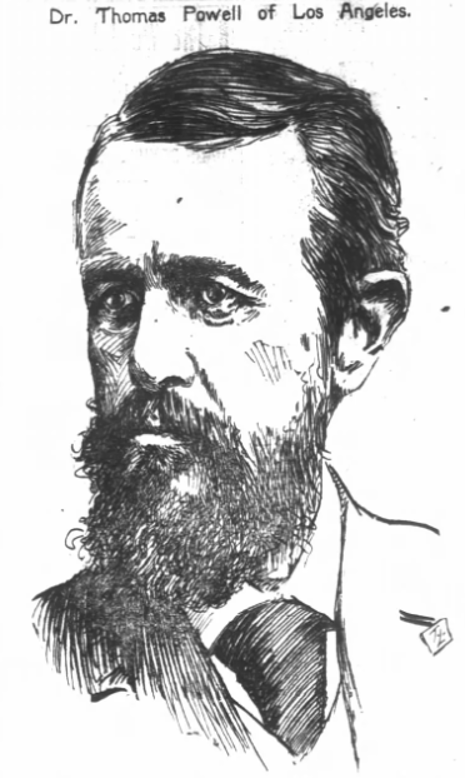
Among the many forgotten pioneers resting at Hollywood Forever Cemetery is a man who spent much of his life challenging the accepted medical wisdom of his day. Dr. Thomas Powell was a physician, author, lecturer, sanitarium founder, and one of the most controversial medical figures of the late nineteenth and early twentieth centuries. Admired by supporters as a visionary and dismissed by critics as a crank, Powell became nationally known as the "germ-eater," a nickname earned through a series of astonishing public experiments in which he deliberately exposed himself to disease-causing organisms to prove his theories. Today, his story remains one of the most unusual in Hollywood Forever's long history.
By Allan R. Ellenberger

Thomas Powell was born on September 21, 1837, in Clarksville, Tennessee. Little survives about his childhood, but he came of age during a period when medicine was undergoing dramatic transformation. The Civil War era and the decades that followed witnessed rapid advances in surgery, bacteriology, and scientific understanding. Yet Powell eventually became one of the most vocal critics of one of medicine's most revolutionary developments: the germ theory of disease.
By the time he settled in Los Angeles, Powell had established himself as a physician, writer, and lecturer. He founded the Powell Sanitarium at 313 West Third Street and became one of Southern California's best-known medical personalities. Contemporary newspapers described him as one of Los Angeles' leading physicians, and he contributed regularly to medical journals while publishing several books outlining his unconventional theories. Powell's central belief was radical for his time. He argued that all disease stemmed from a single cause: improperly digested food.
According to his theory, poorly assimilated food created a toxic substance he called "pathogen," which accumulated throughout the body and produced various illnesses. Tuberculosis, heart disease, rheumatism, Bright's disease, cirrhosis, and countless other ailments were, in his view, merely different manifestations of the same underlying condition. He rejected the prevailing belief that bacteria and germs were responsible for disease, insisting instead that microorganisms thrived only in bodies already weakened by this internal toxic buildup.
To prove his point, Powell undertook experiments that made him famous nationwide. Newspapers reported that he challenged bacteriologists to expose him to virtually any disease-causing organism they wished. Doctors reportedly fed him cultures containing dangerous bacilli, exposed him to cholera organisms, scarified his throat and applied diphtheria cultures, and had him inhale sputum from tuberculosis patients. According to contemporary accounts, Powell never developed symptoms. Newspapers marveled that laboratory animals subjected to similar treatment often died while Powell remained healthy. Whether his demonstrations were scientifically valid remains highly questionable by modern standards, but they made him a sensation.
The press seized upon the story. One headline proclaimed that Powell had died "still a victor over every known kind of pernicious microscopic bug." Another referred to him simply as the famous "germ-eater." Even his critics acknowledged his courage. As one newspaper observed, the confidence with which he submitted himself to such experiments stemmed entirely from his conviction that his nutritional theories protected him from disease.
Powell was not merely a showman. He was also a prolific writer and lecturer who genuinely believed he had discovered a revolutionary approach to human health. He authored numerous medical works and spent years promoting dietary reform and preventive medicine. He argued that food must be digested so thoroughly that it became a perfectly assimilated liquid capable of nourishing body tissues without creating harmful waste products. White blood cells, which conventional medicine viewed as defenders against infection, were interpreted by Powell as accumulations of the very toxic substances he believed caused disease.
While mainstream medicine never embraced his theories, Powell attracted devoted followers who admired his willingness to challenge established authority. He was active in numerous professional and civic organizations, including the American Public Health Association, the American Health League, the American Association for the Study and Prevention of Infant Mortality, the Southern California Academy of Sciences, the Royal Society Club of London, the Masons, and Los Angeles' Celtic Club. His reputation extended far beyond California, making him one of the city's best-known physicians during the early twentieth century.
As he entered his late seventies, however, Powell's health began to fail. Ironically, despite his lifelong battle against accepted medical theories, he was ultimately overcome by illness. Contemporary reports noted that he had been steadily declining during his final years and had become increasingly unable to attend to his practice.
Dr. Thomas Powell died at his residence at 1413 Girard Street (1413 West 11th Street today) in Los Angeles on August 17, 1916. He was 79 years old. Newspaper reports attributed his death to a nervous breakdown brought on by overwork, but official records identified carcinoma of the liver as the cause. His passing attracted considerable attention because of his long-standing notoriety and the irony that a man who had publicly challenged disease for decades had finally succumbed to illness himself.
Funeral services were held on August 19, 1916, at the First Christian Church at Eleventh and Hope Streets. The service drew representatives from many of the organizations with which Powell had been associated throughout his long career. He was survived by his widow, Clara Powell, a daughter, Ruth, and a son, Verne Powell of Boston.
Following the funeral, Dr. Thomas Powell was interred at Hollywood Cemetery. There he rests in Section 9, Grave 421, in an unmarked grave that gives little indication of the extraordinary life it conceals.
History has not been especially kind to Powell's medical theories. Germ theory has since been proven overwhelmingly validated by modern science and nearly all of his findings have been disproved. However, labeling him simply as a medical crackpot overlooks the realities of his time. Dr. Thomas Powell was a member of the first generation of physicians who practiced medicine at a time when the field was exploding with new information and hotly contested opinions. He was bold, intellectually obstinate, infinitely curious, and completely confident that he had figured out something that everyone else had missed. Whether you consider him a rebel with bad intentions or a misguided do-gooder, Dr. Thomas Powell is one of Hollywood Forever's most interesting Forgotten Souls. He literally ate germs to prove his point.

The white arrow indicates the final resting place of Dr. Thomas Powell, whose grave remains unmarked.
Tomorrow on The Hollywoodland Revue: this week’s “Coming Attractions” roundup featuring the newest theatrical releases, critical reactions, audience buzz, and recommendations on what may—or may not—be worth your ticket money.
If you enjoyed my profile of Dr. Thomas Powell—the controversial physician known as the "Germ-Eater"—please leave a comment, rate the article, and share it with fellow readers who enjoy discovering Hollywood Forever Cemetery's most fascinating forgotten figures.
Add comment
Comments
I never knew about the "Germ Eater." Kudos Allan, for sharing his story!
Thanks James, I appreciate your comments. Glad you liked it.
Thank you for this glimpse of an unorthodox life. And for including accurate street addresses. Some of the street names may have changed, but the essence of lives well lived remains.
Thanks for your comments, Mark. It's good to hear from you.