

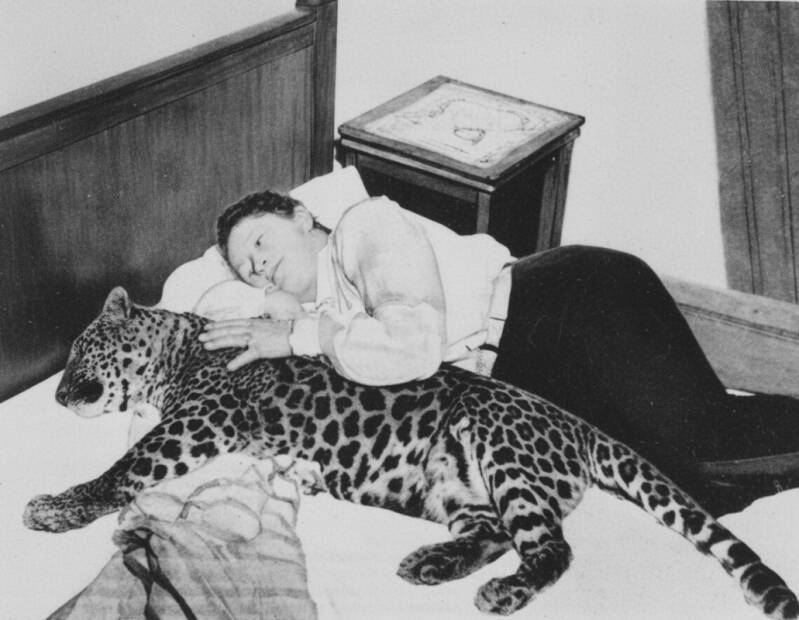
Even long before movie stars became the main draw of Hollywood, there was another type of celebrity who held the public's attention. This small Swedish immigrant would calmly walk into cages containing furious leopards and end up gaining their full trust. Olga Celeste, who was known all over the world as the 'Leopard Lady', was one of the real pioneers of the motion picture industry. When few women were allowed to work with dangerous animals, she established an outstanding career by carrying out exactly what everyone else regarded as impossible. For over forty years she trained wild cats for circuses, vaudeville, and films, helping to determine the appearance of early Hollywood adventure movies and at the same time winning the respect of both filmmakers and audiences.
By Allan R. Ellenberger

Olga Celeste was born Olga Cecilia Knutson on 9 April 1888 in Sweden; her father worked as a horse trainer, and it was from him that she acquired an instinctive knowledge of animals. Later in life she often gave the following account of her childhood, saying that she had always been fascinated by horses and that when she was only eleven years old, she had run away from home with the intention of joining a circus. Although her family soon located her and returned her home, her wish to work with animals never disappeared. At the age of sixteen she left Sweden for America and arrived in Chicago to live with an older sister, whereupon fate stepped in.
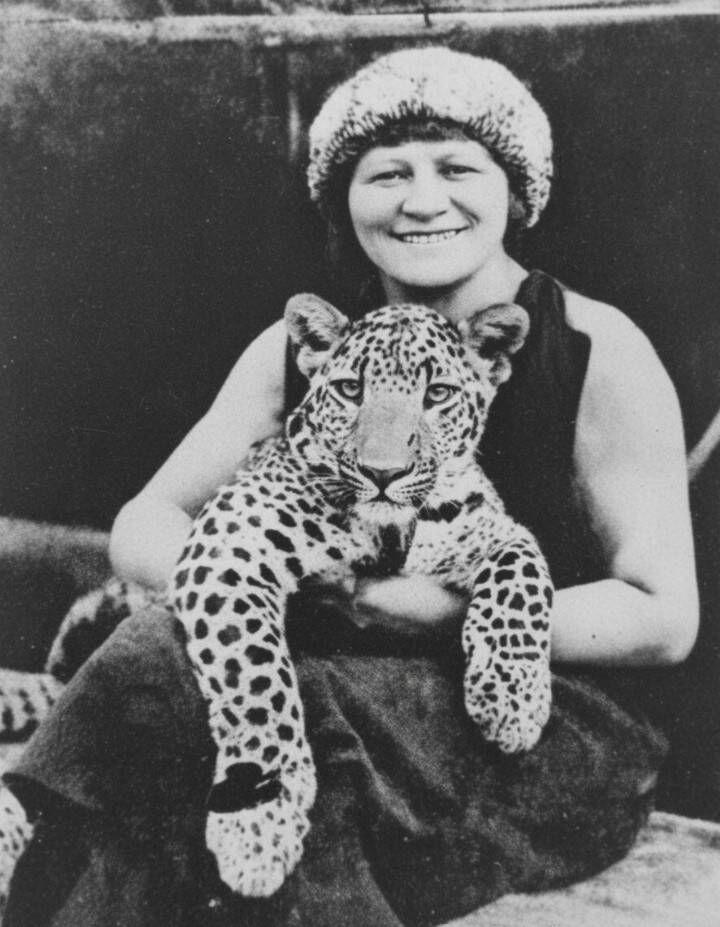
In Chicago Olga obtained a position with the well-known Big Otto Wild Animal Show. At first, she was in charge of dogs and ponies, but soon her interest shifted to the leopards, which fascinated her much more than any domestic animal. Although most of the trainers thought that leopards were too unpredictable to handle safely, Olga believed that they only needed patience, consistency, and respect. She once said that the secret was never letting fear take control of the relationship; this attitude would characterize the whole of her career.
Colonel William N. Selig, one of the founders of the American motion picture industry, soon became aware of her talents. Upon expanding his filmmaking business, Olga joined his organization and travelled west with it as his company set up what later became the well-known Selig Zoo in Los Angeles; there she discovered the ideal combination of her two interests: wild animals and motion pictures.
In the silent film period, exotic animals became extremely popular with audiences, and Olga soon became the foremost leopard trainer in the industry. She appeared before the camera in the early jungle adventure films, such as The Leopard Queen (1909), and also took on the role of double for actresses in dangerous scenes involving animals. Furthermore, she assisted in training animals for some of Selig's more ambitious films, including The Adventures of Kathlyn, which was one of the first American film serials. Many years later, she was regarded as the first woman to train wild animals specifically for the purpose of motion pictures, thus establishing a profession that had been almost entirely closed to women.
The more famous she became, the more legends accumulated about her. The newspapers often claimed that she had appeared in or trained animals for over a thousand motion pictures. Although it was uncertain whether that remarkable figure was completely true, there was no doubt that she became one of Hollywood's essential figures working behind the scenes. Whenever a leopard or a puma appeared in a film, generations of filmmakers relied on her. One film that took advantage of her skills was Howard Hawks' favourite comedy Bringing Up Baby (1938), in which she trained the leopard who appeared opposite Katharine Hepburn and Cary Grant.
Olga's activities went well beyond those in Hollywood. From the 1910s through to the 1920s she toured with several large circuses, such as the John Robinson Circus, the Al G. Barnes Circus, and Ringling Bros. and Barnum & Bailey. People would fill the tents to see the small trainer quietly go into cages containing strong cats and carry out feats which appeared almost impossible. Her performances were exciting not since they were based on cruelty or domination, but because they showed an exceptional relationship between trainer and animal.

At the Selig Zoo, which was later called Zoopark, she attained a fame comparable to that of the animals. A major draw at the zoo was her famous "leopard tea party," at which the skilled trainer was seen sitting at a table among her spotted colleagues as if entertaining well-brought-up guests. The performances became a fixed feature of Los Angeles and gave thousands of people from Southern California their first introduction to the remarkable woman who seemed to have no fears whatever when it came to using her claws.
Even though she received a great deal of glamorous publicity, Olga's life involved making continuous sacrifices. She did suffer injuries throughout her long career, even so, only a small number considering how dangerous her job was. Friends remembered that she always maintained that success needed "patience, a good steady nerve and the ability to keep your mind on your work." She thought that fear was the one thing that wild animals picked up on at once. On the basis of what those who knew her said, she never approached a leopard with any hesitation, and maybe because of this they saw her as one of their own.

Her private life was much more modest than her public career. She got married to another animal trainer, Charles Murphy, around 1910; Murphy too was involved in the film industry and later took charge of the Universal City Zoo. The couple eventually divorced and had no children. Olga spent almost all her time on the animals who became her lifelong companions and frequently called them affectionately 'my babies.'
The closure of the Selig Zoo represented one of the most sorrowful periods in her life. Following extensive damage caused by floods in 1938 and a general decline in its condition, the Zoopark shut down in 1940. Rather than let her cherished leopards be sold off without any regard, Olga mortgaged her furniture and borrowed money from her friends in order to buy the five leopards and three lions herself. She later stated that she couldn't stand the idea of someone else hurting them. The choice imposed a huge financial strain on her, yet she never regretted it. She looked after the animals until the last one died in 1954, thus ending nearly fifty years of dedication to the creatures she loved most.
When she retired, Olga lived a quiet life in Burbank, far away from the excitement of circus tents and movie studios. Nevertheless, she was still a cherished figure amongst the older people in Hollywood who remembered both her courage and her professionalism. On August 31, 1969, after having been hospitalized with pneumonia, she had a heart attack and died at the Burbank Community Hospital at the age of eighty-one. The newspapers paid tribute to her not only as the famous 'Leopard Lady' but also as one of the last remaining connections to the early days of Hollywood filmmaking. The Los Angeles Times pointed out that from 1910 until her retirement in 1954 she had taken part in or trained animals for almost every film that included leopards.
The funeral took place on September 8, 1969, with Olga Celeste being buried at Evergreen Memorial Park in Boyle Heights alongside her long-time companion, Emma Bell Clifford (who died the previous June). It was a simple conclusion for a woman whose outstanding career had a major role in shaping a whole period of circus entertainment and the early days of motion pictures.
Olga Celeste is nowadays remembered less frequently than a great many of the actors whose films she had helped to bring about, but her impact continues quietly. She demonstrated that women could achieve success in one of the most hazardous occupations in the entertainment industry, was the pioneer in training wild animals for use in films and contributed to the creation of some of the most unforgettable sights of the silent film era. Although Hollywood tended to celebrate its stars, behind a number of its most impressive adventures there was a bold Swedish immigrant who realized that the secret to mastering wild animals was never force—it was trust.
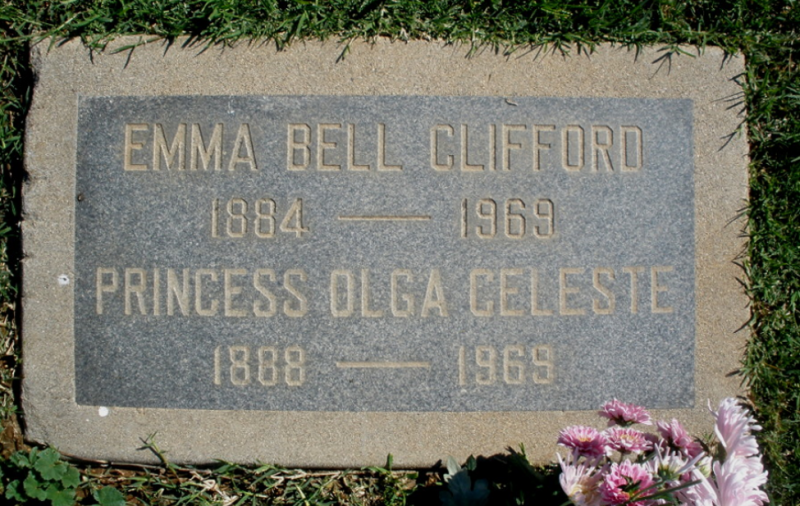
Olga Celeste is laid to rest at Evergreen Memorial Park in Boyle Heights beside her longtime companion, Emma Bell Clifford, bringing to a close the remarkable life of Hollywood's legendary "Leopard Lady." (Photo Credit: Findagrave/Mark Masek).
Be sure to check back tomorrow as The Hollywoodland Revue uncovers the fascinating—and often unbelievable—story of Dr. Thomas Powell, the self-proclaimed "Germ Eater," whose bizarre health theories made headlines around the world. Discover his controversial life, remarkable career, and why this eccentric physician now rests at Hollywood Forever Cemetery.
Did Olga Celeste's remarkable story surprise you? I'd love to hear your thoughts! Please leave a comment, rate the article, and share it with fellow classic film and Hollywood history enthusiasts. Help celebrate the fearless "Leopard Lady," whose extraordinary courage and pioneering work with big cats left an unforgettable mark on the early motion picture industry.
Add comment
Comments