

When Albert Einstein arrived in Southern California at the end of 1930, Los Angeles greeted him with an unusual combination of sunlight, scientific reverence and Hollywood stardust. He had come primarily to work at the California Institute of Technology in Pasadena, but Einstein was already more than a physicist. Since the dramatic confirmation of his theory of relativity in 1919, he had become one of the most recognizable men in the world.
By Allan R. Ellenberger

Albert Einstein attends the 1931 premiere of City Lights as Charlie Chaplin’s guest at the grand opening of downtown Los Angeles’s new Los Angeles Theatre.
Hollywood understood fame, even when it did not understand relativity. Einstein spent three winter terms at Caltech, in 1931, 1932 and 1933, working with leading scientists and lecturing on the nature of space, time and the universe. He and his wife, Elsa, stayed in Pasadena, but reporters, society figures and photographers followed his movements with the eagerness usually reserved for movie stars. His unruly hair, rumpled clothing and thoughtful expression made him instantly recognizable.
The film colony soon came calling and captured the strange collision between theoretical physics and movie-town showmanship. Einstein was portrayed as a gentle, bemused visitor surrounded by producers, actors and publicity men eager to claim some connection to the world’s most famous scientist.
One humorous story described Einstein attempting to explain his theories to a studio executive by using the distant star Betelgeuse as an example. The executive immediately telephoned his casting department and ordered them to sign “Miss Betelgeuse” before a rival studio could get her. The incident was probably invented, but it perfectly expressed Hollywood’s attitude: if there were stars anywhere in the universe, the studios wanted them under contract.
Universal Pictures arranged one of the most elaborate welcomes. Einstein, a committed pacifist, had heard about Lewis Milestone’s antiwar film All Quiet on the Western Front and accepted an invitation to see it. What he apparently did not realize was that Universal scheduled the screening during the studio’s twenty-fifth anniversary celebration.
When Einstein arrived, he found himself surrounded by celebrities, executives and members of Universal founder Carl Laemmle’s enormous family. Mary Pickford, Gary Cooper and Will Rogers were among those reported to be present. The guests seemed at least as interested in seeing Einstein as they were in honoring the studio.
When Mary Pickford greeted him warmly, Einstein reportedly turned to an interpreter and asked in German, “Who is that?” Elsa rescued the moment by reminding him that they had traveled to America aboard the same ship once used by Pickford’s husband, Douglas Fairbanks. Hollywood had met the man who understood the structure of the universe but apparently did not recognize “America’s Sweetheart.”
The gathering also inspired a joke about Laemmle’s many relatives. After seeing them gathered together, someone imagined the studio chief saying to Einstein, “What! You’re telling me about relativity?”
At Universal, studio technicians showed Einstein how motion pictures were photographed and recorded. Rows of cameramen filmed him as sound equipment captured his voice. When the developed film was later screened, Einstein reportedly became uneasy and said he wished the pictures had not been broadcast. Laemmle assured him that they would not be released, though the professor apparently remained suspicious of the entire process.
Hollywood’s publicity men were fascinated by Einstein but did not always know what to do with him. Some even confused him with Sergei Eisenstein, the Russian director who had recently visited the film capital. In a town built upon famous names, the difference between Einstein and Eisenstein occasionally caused comic uncertainty.

Carl Laemmle, reportedly referring to his relatives while giving Einstein a tour of the Universal lot during the studio's twenty-fifth-anniversary celebration, prompted the inevitable joke: “You tell me about relativity?”
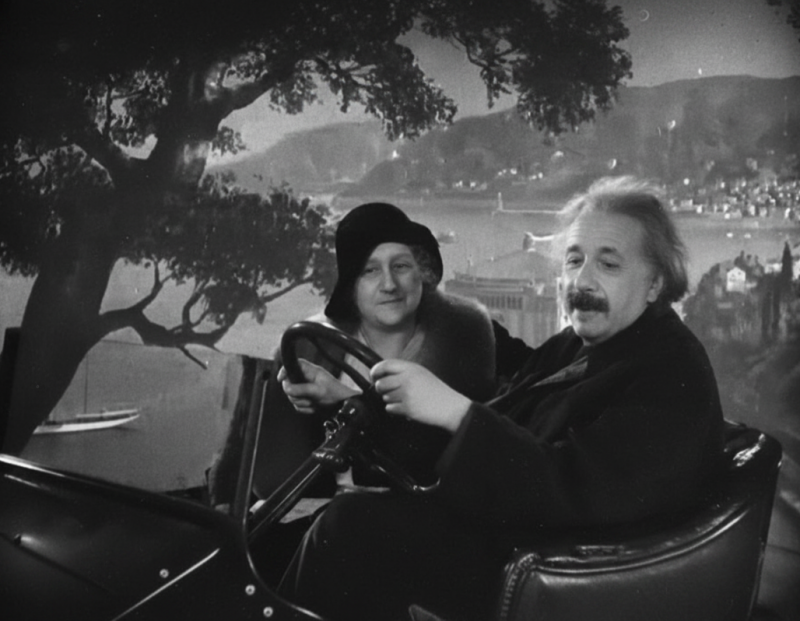
At Warner Bros., Albert and Elsa Einstein experienced the magic of trick photography, sitting in a stationary automobile that appeared on film to carry them through Hollywood, Paris, and Berlin.
At Warner Bros., Einstein and Elsa participated in a demonstration of movie trick photography. They sat inside an old automobile mounted before a screen while technicians shook the vehicle and cameras rolled. Within hours, Einstein watched himself apparently driving through Hollywood, Paris and Berlin. The man who had transformed scientific ideas about reality now watched Hollywood manufacture its own version of it.
His Warner Bros. appearance also produced one of the most colorful stories of his visit. John Barrymore was then filming Svengali, wearing the character’s long hair and heavy beard. Studio officials invited him to lunch with Einstein, but Barrymore, unwilling to leave the set in full makeup, sent a photograph for the professor to autograph. Einstein declined.
When told that Barrymore could not attend the luncheon, Einstein reportedly suggested that the actor come to him. Barrymore refused, and the proposed meeting collapsed into what was gleefully presented as the “battle of Einstein versus Barrymore.” The clash may have been exaggerated for entertainment, but it offered an irresistible contrast: Barrymore, the grand theatrical star accustomed to being pursued, and Einstein, the scientific celebrity who seemed serenely unaware of Hollywood protocol.
Einstein also visited Metro-Goldwyn-Mayer, where German-speaking studio employees greeted him in his native language. He appeared relieved to hear familiar words after so many ceremonies and introductions.
At Fox, he reportedly watched the filming of a German-language production. Before dubbing became common, studios often produced alternate-language versions of films using different casts. Einstein observed the process with interest, though one account claimed he complained that the German performers spoke too loudly.

Albert Einstein, at left, visits Mount Wilson Observatory with a group of scientists; pictured with him are observatory director Walter S. Adams, center, and Dr. William W. Campbell of Lick Observatory.
Hollywood was only one part of Einstein’s California experience. In January 1931, he visited Mount Wilson Observatory, where Edwin Hubble and Walter Adams showed him the great 100-inch Hooker telescope. Hubble’s studies of distant galaxies had provided evidence that the universe was expanding, forcing Einstein to reconsider some of his own cosmological ideas.
At Mount Wilson, away from the studio crowds, Einstein confronted another kind of spectacle. Hollywood used light to create imaginary worlds. The observatory gathered light that had traveled across the universe. Beneath its dome, Einstein was not merely a celebrity but a scientist looking outward into the cosmos his equations had helped explain.
His most famous Hollywood encounter was with Charlie Chaplin. Einstein had reportedly said that Chaplin was the one man in the film colony he especially wished to meet. Chaplin invited Albert and Elsa to attend the Los Angeles premiere of City Lights on January 30, 1931.
When Chaplin and Einstein arrived together, the crowd erupted. Police struggled to restrain spectators while cameras captured the unlikely pair: the small, elegantly dressed comedian beside the rumpled scientist with the wild hair.
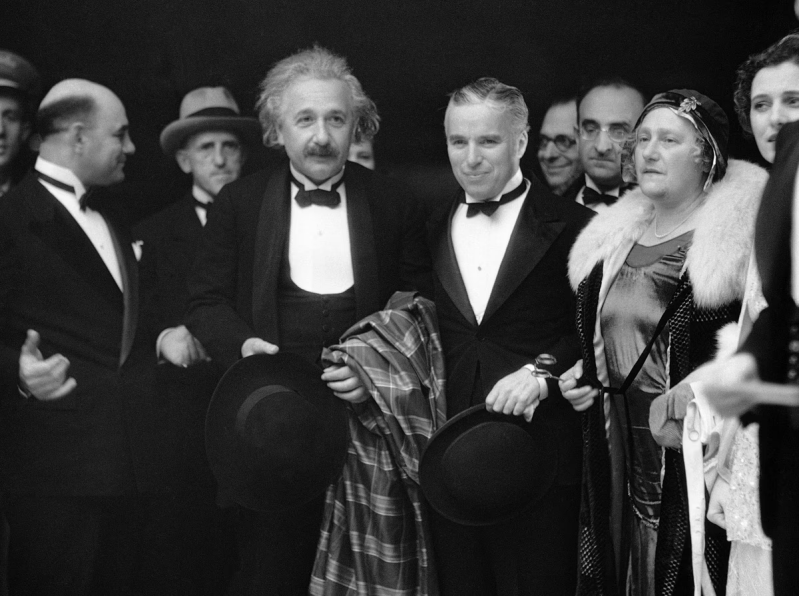
On February 2, 1931, Charlie Chaplin, center-right, attends the Los Angeles premiere of City Lights with his guests of honor, Albert Einstein and Einstein’s wife, Elsa. AP
A famous exchange was later attributed to them. Chaplin supposedly told Einstein, “They applaud me because everybody understands me, and they applaud you because no one understands you.”
The exact wording may have changed through repeated retellings, but the remark survived because it seemed perfect. Chaplin communicated without words to audiences around the world. Einstein used mathematics that few people could fully comprehend. Both had become universal symbols.
Einstein reportedly watched City Lights with great pleasure. The film told its story largely through pantomime at a time when talking pictures had taken control of the industry. For a man who sometimes struggled with English and who understood the expressive power of ideas beyond ordinary language, Chaplin’s art may have seemed especially direct.
Throughout his Hollywood visits, Einstein behaved with curiosity rather than condescension. He studied cameras, microphones, lighting equipment and optical effects with genuine interest. Motion pictures united science and imagination through chemistry, mechanics, electricity and the manipulation of time—subjects not entirely foreign to a physicist.
Hollywood, meanwhile, regarded him with almost superstitious admiration. Actors and executives accustomed to being the center of attention eagerly sought introductions. They may not have understood his equations, but they understood that they were standing beside greatness.
His final California visit took place during the winter of 1932–1933, as Germany moved toward dictatorship. When Adolf Hitler became chancellor in January 1933, Einstein was abroad. He renounced his German citizenship and eventually settled permanently in the United States.
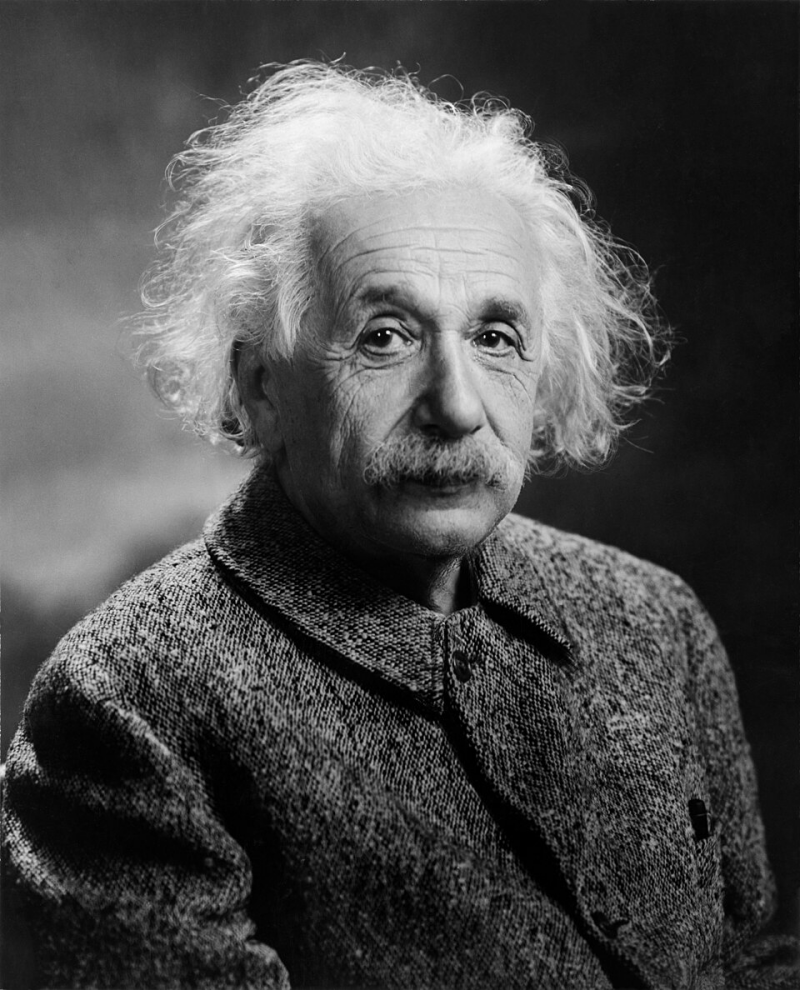
The cheerful photographs of Einstein with Chaplin and the stories of his studio adventures soon belonged to a vanished moment. Europe was descending into darkness, and Einstein’s life would become increasingly shaped by exile, war and the dangers of modern science. Yet Hollywood preserved the lighter memory: Einstein surrounded by cameras, Einstein baffled by movie stars, Einstein watching himself travel through imaginary cities, and Einstein smiling beside Chaplin.
He never needed a screen credit or a star on Hollywood Boulevard. He had already achieved something the studios constantly pursued but could rarely manufacture: worldwide fame based upon an unmistakable identity. Hollywood created illusions. Einstein revealed that reality itself could be more astonishing than anything projected on a screen.
Be sure to check back tomorrow for another journey into Hollywood's fascinating past as The Hollywoodland Revue uncovers another remarkable story from the Golden Age of motion pictures. You never know what forgotten landmark, legendary personality, or little-known chapter of film history we'll bring back into the spotlight next!
Did you know Albert Einstein once toured Hollywood, visited the studios, and attended the premiere of City Lights as Charlie Chaplin’s guest? Please comment, rate, and share my latest blog post exploring the celebrated physicist’s unforgettable encounters with the dream factory.
Add comment
Comments