

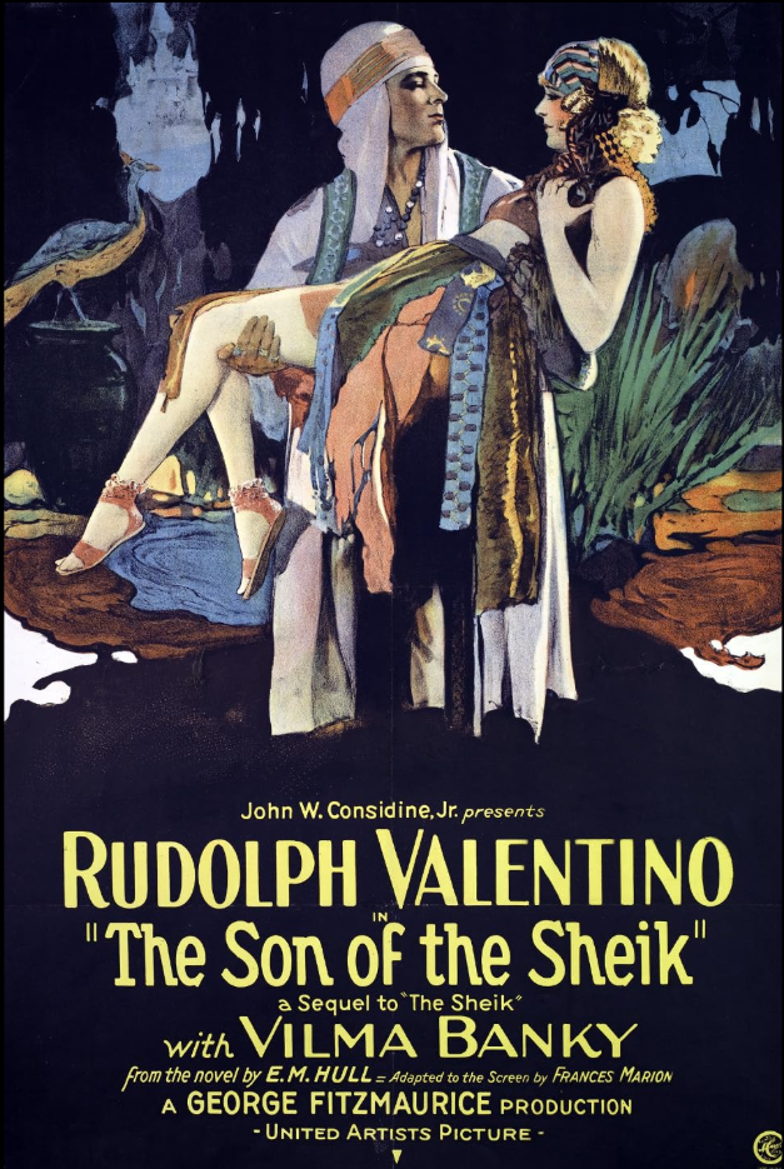
In the summer of 1926, when he was at the peak of his fame, Rudolph Valentino was promoting The Son of the Sheik, the film that was to be his last appearance in a Hollywood movie. Although the public continued to adore him as Hollywood's "Great Lover," Valentino was still a frequent subject of criticism from writers who disliked his foreign origins, his elegance, the fact that he was popular with women, and his refusal to fit in with the narrow American concept of masculinity. This resentment came to a head when the Chicago Tribune published an editorial called "Pink Powder Puffs", a sarcastic attack which did not simply question Valentino's appearance but his manhood; the article led him to launch one of the most well-known challenges in the history of Hollywood.
By Allan R. Ellenberger

While travelling to New York with his manager and close friend S. George Ullman, Valentino became aware of the editorial. The two of them had stopped in Chicago, where a severe Midwestern heat wave caused them to go into the Blackstone Hotel in search of relief. On their way to breakfast, a copy of the Sunday Chicago Tribune was handed to Ullman by someone. As he read the article, Valentino saw that his manager was angry.
“What’s wrong?” he asked.
Ullman paused for a moment, since for four years he had acted not only as Valentino's business manager but also as his adviser and friend. Their relationship started in 1922, the year when Valentino was involved in a severe dispute with Famous Players-Lasky. Having decided to walk out of the agreement, the actor found himself legally barred from appearing in films and was also extremely short of money. At that time Ullman was associated with the Mineralava Beauty Clay Company and arranged for a nationwide promotional dance tour which brought Valentino and his wife, Natacha Rambova, a reported $7,000 a week.
Ullman later remembered that he was immediately overwhelmed by Valentino's personality when they first met. Since both the actor and Rambova were interested in spiritualism and automatic writing, they were certain that one of Valentino's spirit guides had foretold Ullman would become his business manager. Although Ullman was doubtful, particularly as Valentino was deeply in debt, he ultimately took up the position.
Their friendship did survive the turmoil caused by Valentino's marriage to Rambova and the subsequent painful separation of the couple. Nevertheless, the editorial published by the Tribune was a quite different kind of injury; it did not consist of criticism of Valentino's acting or business decisions but rather was a public attack on his masculinity.
The anonymous writer said that he had found a machine in the men's room at the Aragon Ballroom which gave out pink face powder. The idea of men using it appeared to frighten him. He stated that young men would go up to the machine, put in a coin, take the powder and then apply it to their cheeks in front of a mirror.
The editorial then focused on Valentino. The writer expressed his concern about what he regarded as the decline of masculine America and questioned whether face powder, ballroom dancing, sheiks, floppy trousers, slave bracelets, and other allegedly effeminate fashions were related. It was implied by the editorial that Valentino had become the symbol of all that was wrong with modern men.
The last insult brought the screen idol down to the level of "Rudy, the beautiful gardener's boy", after which came a sneer: "Hell’s bells. Oh, sugar."
Ullman saw Valentino reading the article carefully, and the actor's face paled, his eyes grew harder and his body became stiff. Although Valentino had previously been the subject of ridicule, this attack hit directly at his dignity.
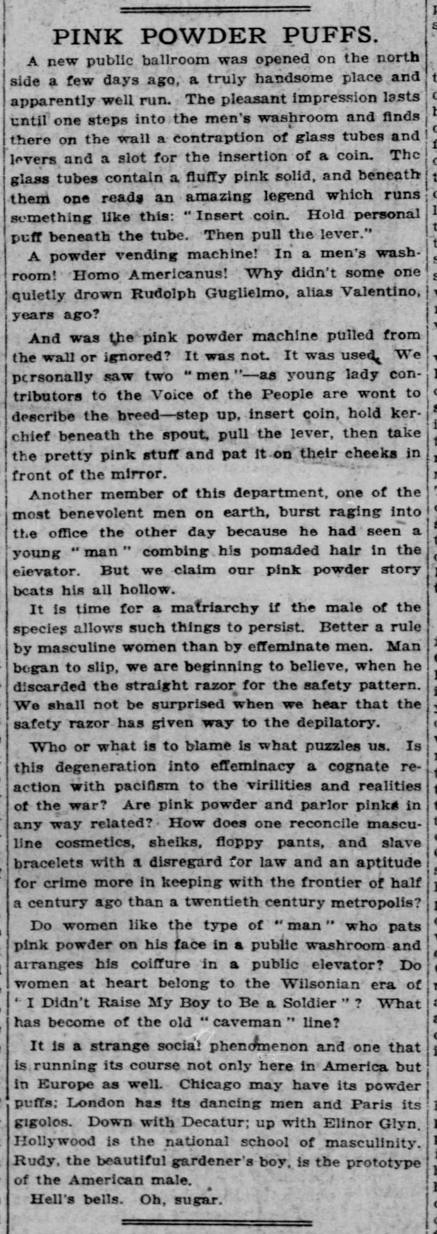
The infamous “Pink Powder Puffs” editorial, reproduced in its entirety, as it appeared in the Chicago Tribune on July 18, 1926.
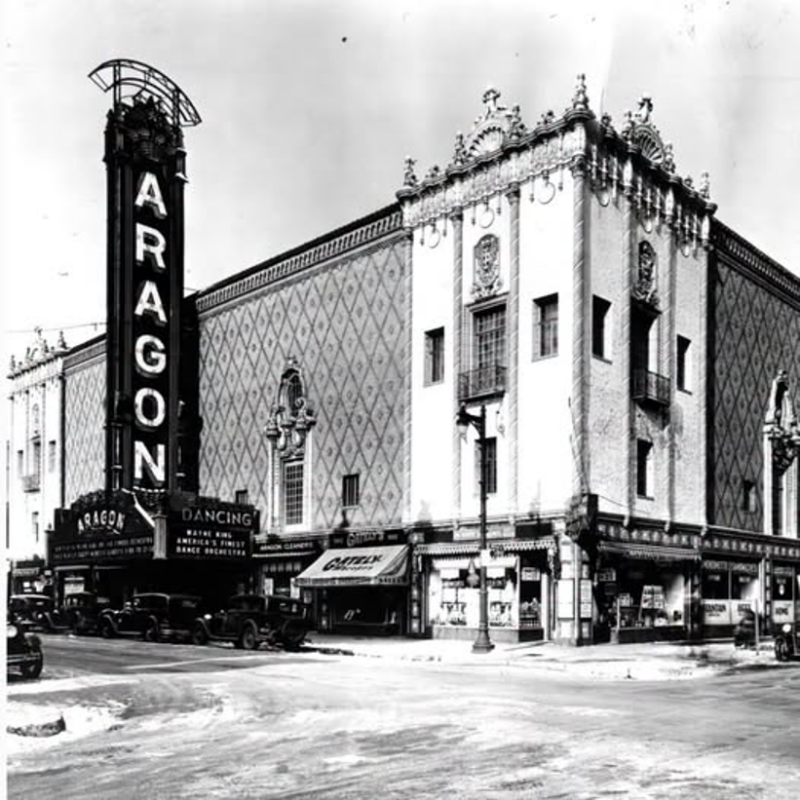
The Aragon Ballroom in Chicago, circa 1926, where the anonymous author of the “Pink Powder Puffs” editorial reportedly saw young men using a machine that dispensed pink face powder and applying it before a mirror.
The hostility was nothing new; since he became an international sensation with The Four Horsemen of the Apocalypse, Valentino had earned the admiration of women and the resentment of many men, for his slicked-back hair, graceful dancing, foreign accent, elaborate costumes, jewelry, and carefully maintained appearance went against the rugged masculine ideal which was celebrated in American culture.
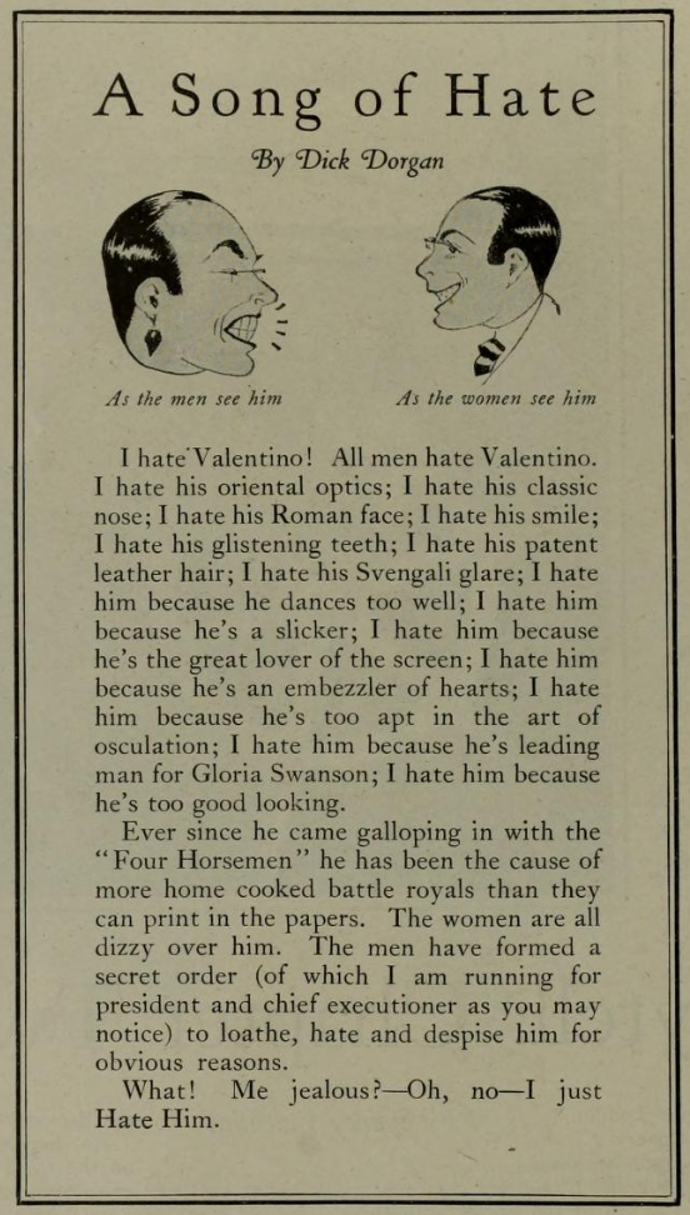
In 1922, cartoonist Dick Dorgan wrote a piece in Photoplay called 'A Song of Hate', a satirical article which pretended to give reasons for men's hatred of Valentino. He ridiculed Valentino's hair, his teeth, the way he danced, his romantic appeal and the fact that he had such great success with women. The humor was mainly based on jealousy, although Valentino did not find it funny.
A few months before this, Dorgan had used an ethnic slur against the star, calling him a "bum Arab" and insulting his Italian origins. On this account, Valentino went into the offices of Famous Players-Lasky and demanded that Dorgan be forbidden from entering the studio. Both Jesse Lasky and Adolph Zukor decided that the comment had been offensive, and the editor of Photoplay, James Quirk, promised to reprimand the writer. Nevertheless, when the article 'A Song of Hate' was published later on, Valentino confronted the studio once again and threatened to boycott both its New York office and the premiere of Blood and Sand. Lasky eventually gave in.
The issue was not limited to a single columnist; Valentino's appearance disturbed men who saw him as a foreigner seducing American women. Some mocked his skin color and called him Rudolph "Vaselino," while others concentrated on the slave bracelet he was wearing, viewing it as an indication of effeminacy. In fact, the bracelet had been a custom-made Christmas present from Rambova, having been designed from a drawing she had produced. Valentino kept on wearing it even after their separation and divorce, although it drew ridicule.
His movies at times increased the sense of hostility. In The Young Rajah and Monsieur Beaucaire, Valentino wore elaborate costumes which were designed by Rambova. Costumes which look theatrical and excessive to modern viewers seemed to some observers from the 1920s to be dangerously unmanly.
Columnist Herbert Howe stated in Photoplay that following Valentino's performance of the tango in The Four Horsemen, male actors started to wear scarves, have bobbed hair, dress in silk clothing, and adopt other fashionable styles. Howe cautioned that the public could tolerate a certain number of ruffles before they would rebel against them.
Few of these articles made their accusations plainly. In the more respectable newspapers, homosexuality was generally dealt with by means of implication, code expressions, and innuendo. The 'Pink Powder Puffs' editorial was in keeping with this approach; the way it referred to powder machines, sheiks, bracelets, cosmetics, and 'Homo Americanus' left little room for doubt as to what the writer meant for readers to suspect.
Debate about Valentino's sexuality has still aroused controversy long after his death. A number of biographers and fans have maintained that he was gay; some think that he might have been bisexual; while others completely dismiss the idea.
Most of the rumors are based on insufficient or no evidence at all. The female impersonator Ray Bourbon later said that he had an affair with Valentino, but Bourbon was famous for his vivid exaggerations. As the stories concerning a supposed relationship between Valentino and actor Ramon Novarro developed over time, they became more and more bizarre, eventually alleging that a mythical phallic gift had been used in Novarro's murder. This story is clearly false; Novarro was beaten with a cane when he was attacked and died from suffocation due to blood getting into his throat; nevertheless, no such object was found during the investigation into his murder or in the inventory of his estate.
There were also various stories about men who gave assistance to Valentino when he was doing poorly, such as the actor Norman Kerry. However, no solid evidence shows that these friendships had a sexual character. Although Valentino might have had experiences which were never put down in writing, speculation does not amount to documentation.
It is clear that Valentino loved women, especially Rambova. Her absence caused him lasting pain. His marriages were unhappy. Still, he had many romantic relationships with women. Whether he ever had a same-sex encounter is impossible to know. The available record does not give a definite answer.
For Valentino, though, the truth about his private life was not the main point; it was the careless cruelty of a stranger making a public mockery of his heritage, his taste, his appearance, and his manhood.
Oscar Doob, who was promoting The Son of the Sheik, stated that it might have been Doob himself who proposed that Valentino should challenge the editorial writer. Doob remembered that Valentino was usually unconcerned about criticism but got angry whenever the editorial insulted his family and his nationality. Of course, such a challenge would also bring about considerable publicity for the new film.
Valentino eventually admitted that perhaps someone had assisted him in writing the challenge letter, but he maintained that the anger expressed in it was real. He postponed his leave from Chicago and issued the challenge in the Chicago Herald-Examiner, a newspaper that was the Tribune’s rival.
Above: journalist and cartoonist Dick Dorgan. Below: his first published attack on Rudolph Valentino, which appeared in the July 1922 issue of Photoplay magazine.
The statement started by addressing the man who had written the editorial entitled 'Pink Powder Puffs'. Valentino referred to the anonymous author as a "contemptible coward" and dared him to show which of them was the better man. As dueling was illegal, he suggested a boxing or wrestling match instead.
At a press conference held at the Blackstone Hotel, Valentino stated that although critics were at liberty to call him a bad actor, he would not put up with ridicule of his private life and his personal tastes. He particularly objected to being described as a "spaghetti gargling gardener’s helper" and to the idea that a supposedly superior Anglo-Saxon person should be thankful that he was not like Valentino.
Valentino was proud to explain his background. He had gone to college in Italy, taken part in athletic activities, and studied landscape gardening, a field that he considered an art form respected on a par with architecture and painting. According to him, his family was highly regarded in Italy.

Illustration of Valentino on the cover of Screenland, March 1923.
Check in tomorrow for the story of Rosa Rosanova, Rudolph Valentino’s memorable costar and one of silent Hollywood’s distinguished character actresses, now resting at Hollywood Forever Cemetery.
If the writer declined the physical challenge, Valentino asked for a retraction. No one then came forward as a challenger and the anonymous author said nothing, the Tribune also giving no official reply. Behind the scenes the newspaper's management regarded the whole matter as a publicity scheme for The Son of the Sheik. It may have been at least in part so. The Hollywood publicity departments knew how valuable controversy could be, and Valentino's anger led to headlines appearing all over the country.
The situation was also very personal since for many years Valentino had had to take in the ridicule aimed at his looks, his ethnic background, the way he dressed, his romantic image, and his supposed sexuality. It was then that the insult 'Pink Powder Puffs' became something he could no longer ignore.
The fact is that Valentino's alleged lack of masculinity was largely confined to the minds of insecure observers. He had crossed an ocean, overcome poverty, worked as a dancer, fought against powerful studio executives, built up an international career, and put up with a press that continually either adored him or treated him with humiliation. Although his anger at the editorial might have been impulsive, it was also something that could be understood.
Valentino's challenge did not resolve the dispute; on the contrary, it turned the harsh anonymous editorial into a permanent element of his legend. The writer disappeared from public view, but Valentino's reply remained—a striking instance of Hollywood's most famous romantic idol refusing to stay quiet. By contrast, the others determined the kind of man he was permitted to be.
What do you think of the infamous “Pink Powder Puffs” editorial and Rudolph Valentino’s defiant response? Please leave a comment, rate the article, and share it with others who enjoy classic Hollywood history.
Add comment
Comments
This editorial in my opinion has a lot to do with ‘the lost generation’ after the Great War, the enormous change in society because of women demanding equal rights to men, earning their own money, voting, changing their way of dressing in comfortable clothes, bobbing their hair, dancing etc. The women choose to adore Valentino, a graceful, romantic and beautiful darkskinned Italian, who in no way resembled the Anglo Saxon, the outlaw, the strong men without emotions, the big money makers. In this era older men must have felt very uncomfortable because the world they knew was no longer there. In this era also the upper class had infinite financial resources from the stock exchange, which financed a hedonistic life style. I see the author of this editorial as the Archie Bunker type of the twenties, an old man nostalgic for the old era of the frontier and the Civil War when men were men and women were subordinate to men whatever they did. Rudy was the symbol of the choice of women, making the average American men, especially of the older generation, very uncomfortable. The racism of this older generation is also shining through, as Rudolph was hardly considered white.
Quite the coverage you have assembled here-------
Okay...,? thanks for commenting.