

Rosa Rosanova was never regarded as a glamorous screen star or a romantic leading lady; rather, she established a remarkable career in the silent film era by portraying women who had already lived through hard experiences—such as immigrant mothers, widows, servants, and family matriarchs who were struggling to protect their children in a changing world. Because of her expressive face, her theatrical background, and her natural air of authority, she gave these characters a sense of warmth and dignity that would otherwise have been missing.
By Allan R. Ellenberger

Today she is most famous for the role of Rudolph Valentino's mother in Blood and Sand, but her career included much more than just that one part. She went from performing on the stages of imperial Russia to the motion-picture studios in Hollywood, where she became one of the most moving interpreters in silent cinema of the themes of motherhood, sacrifice, and the immigrant experience.
Rosanova was born on June 23, 1869, in Odessa, which at that time belonged to the Russian Empire and is now part of Ukraine. Very little reliable information remains concerning her childhood. It is stated in the biographical records that she finished her schooling in Moscow when she was sixteen and then travelled throughout Russia with the Svatloff repertory company. She is said to have come to the United States in 1906 as part of the Orlanoff theatrical company.
The experience she had gained during her time on the stage enabled her to acquire abilities which transferred easily to silent films.
Since there was no spoken dialogue, actors had to express their emotions by means of gesture, posture, and facial expression. Rosanova had a face which could show sorrow, pride, disappointment, and tenderness in a very clear way.
When she started appearing regularly in American films, she was already in her early fifties; although Hollywood usually gave older women only minor parts, Rosanova's age and her European background meant that she was particularly useful in films concerned with immigrant families, generational conflict, poverty, and assimilation.
One of her first major roles was in Just Around the Corner in 1921; the next year saw her take on the part which secured for her a reputation as a strong maternal actress. In Hungry Hearts, a production adapted from stories by Anzia Yezierska, Rosanova portrayed Hanneh Levin, the mother of a Russian-Jewish family who were trying to establish a new life on New York’s Lower East Side.
Hanneh's dreams are of dignity, security, and a decent home in America, but she ends up facing poverty, exploitation, and humiliation. Rosanova gave the character more than that of a typical suffering mother; her performance conveyed the mixture of hope and desperation felt by immigrants who had come over the belief that America would reward hard work and only later discovered that the promises made were more complicated.

Helen Ferguson and Rosanova in Hungry Hearts (1922).

Rudolph Valentino and Rosanova in Blood and Sand (1922).
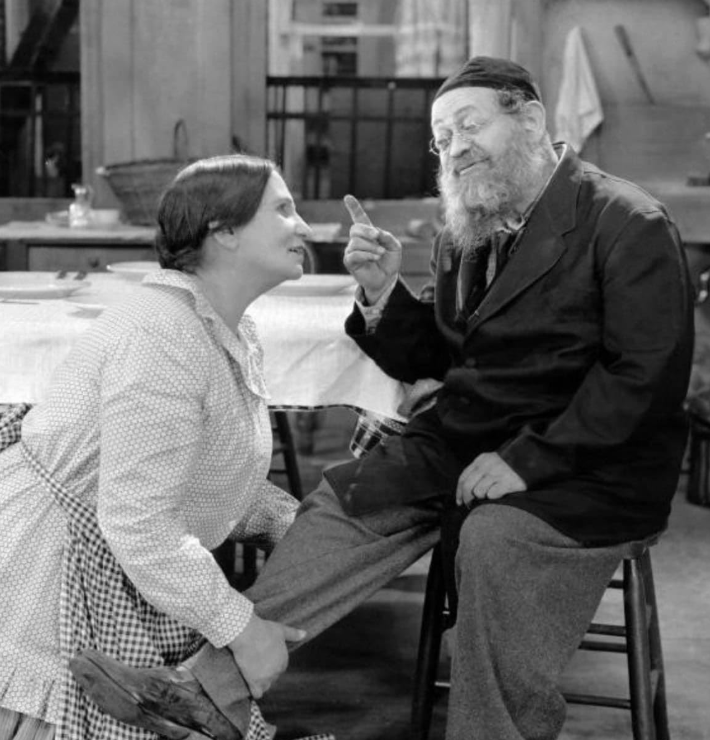
Rosanova and Rudolph Schildkraut (also interred at Hollywood Forever) in His People (1925).
Rosanova also had a role in Fred Niblo’s film Blood and Sand in 1922 as Señora Angustias Gallardo, the mother of Juan Gallardo, who was played by Rudolph Valentino. The film depicts Juan's ascent from poverty to fame as a renowned Spanish bullfighter and the personal ruin that goes with his success.
The emotional core of the story came from Rosanova, who was surrounded by Valentino's charm, Nita Naldi's glamour, and the thrill of the bullring. Since she was Juan's mother, she stood for the simple life he had left behind and the danger that no fame could eliminate. Her love for her son was both protective and full of fear, arising from the fact that celebrity could not save him from the dangers of the arena.
Rosanova once again joined up with Valentino in the film Cobra in 1925. At that time, she had already become a well-known character actress and was often given roles as mothers, widows, servants, and women from European or immigrant backgrounds.
Other films by her were The Gentleman from America, Fashion Row, The Lover of Camille, The Virgin, When a Girl Loves, and A Woman’s Faith. Even though the nationalities and situations of her characters differed, they had certain things in common. Rosanova frequently showed women who had been shaped by adversity, a sense of family loyalty, and traditions which the younger generations were ready to give up.
A significant role that she had later on was in the film His People in 1925; this film depicted the life of a poor Russian-Jewish family residing on the Lower East Side of Manhattan, Rudolph Schildkraut playing David Cominsky, a man who sold goods from a pushcart, and Rosanova appearing as his wife, Rose.
The two sons take very different routes. Morris ends up getting an education and achieving professional success, but he later feels ashamed of his immigrant parents. Sammy, on the other hand, stays faithful and provides support for the family. Rosanova's Rose acts as the emotional link between her husband and her sons, representing both the sorrow caused by rejection and the hope for reconciliation.
The story illustrated the experiences of a large number of immigrant families whose children tried to become fully American by getting rid of their parents' accents, customs, and their poverty. Rosanova had a personal understanding of this conflict. Indeed, just as many of the women she portrayed, she too had left the Russian Empire and had built up a new life in the United States.

In the second half of the 1920s, Rosanova took part in a number of domestic comedies and melodramas which focused on Jewish, Irish and immigrant families; the films included her playing Mrs. Dufour in God Gave Me Twenty Cents, Mrs. Levine in Jake the Plumber, Sarah Weinberg in Pleasure Before Business, and Mrs. Cohen in The Shamrock and the Rose.
She was also in the film adaptation of Abie's Irish Rose, a comedy that dealt with the conflicts between Jewish and Irish Catholic families. Although such movies usually featured exaggerated accents and ethnic humor, performers such as Rosanova managed to give their characters a sense of warmth and emotional credibility.
In 1929 she took on the role of 'Momma' Jessel, playing against the entertainer George Jessel. She also appeared in Frank Capra's The Younger Generation as Tilda Goldfish, the mother of a young man who rises from poverty and attempts to hide his Jewish background. Once more, Rosanova portrayed the family and heritage left behind as a result of the pursuit of social acceptance.
Although the introduction of sound did not completely bring an end to her career, it did reduce the range of roles available to her. Because of her accent, her age, and the fact that she was linked with the melodramas of the silent film era, she was gradually restricted to smaller parts. She took part in some of the early sound films, such as After Tomorrow and John Ford’s Pilgrimage, in which she played the role of Mrs. Goldstein, a Gold Star mother. One of her last known appearances on screen was in Fighting Hero in 1934.

Grave of Rosa Rosanova in Beth Olam section, Garden of Jerusalem (Sect. 18), Grave 310.
Tomorrow on The Hollywoodland Revue: this week’s “Coming Attractions” roundup featuring the newest theatrical releases, critical reactions, audience buzz, and recommendations on what may—or may not—be worth your ticket money.
Rosanova kept a large part of her private life to herself. Later on, two children, Esther and Lewis, were identified, but very little reliable information has survived concerning her marriage or her family relationships. In the same way as so many character actresses did, she worked continuously without being given the amount of publicity that was given to the leading stars.
Rosa Rosanova died at her home, 122 Ocean Park Boulevard in Santa Monica, on May 29, 1944, from a coronary thrombosis a month before her seventy-fifth birthday. At that time, she had been out of films for almost ten years and the silent period during which she had thrived now appeared to be part of a different era. She lies in the Beth Olam section of Hollywood Forever.
Rosanova's reputation is not based on traditional stardom; rather it endures because of the emotional truth she conveyed in her portrayal of supporting characters—such as mothers whose children were ashamed of them, immigrants whose faith in America was put to the test, and women who showed their love by means of sacrifice and endurance.
In a business obsessed with youth and beauty, Rosa Rosanova found power in age, experience, and sorrow. She deserves to be remembered not simply as Rudolph Valentino’s screen mother, but as one of silent Hollywood’s most moving interpreters of the immigrant family.
Please take a moment to comment on, rate, and share my latest blog post about Rosa Rosanova, the gifted character actress whose warmth, dignity, and maternal screen presence made her a memorable figure of silent Hollywood.

Add comment
Comments