

On August 23, 1926, Hollywood suffered the loss of its first genuine superstar. Thousands of sorrowful fans gathered on the streets outside New York's Frank E. Campbell Funeral Chapel. Some women collapsed, men scaled the cars in order to get a better view, and the police had great difficulty in managing the growing crowd. Reporters were sent by the newspapers to report on the event as though it were a national emergency. The man who had died was not a president, a military hero, or an industrial giant. He was an actor. Yet no film star had previously aroused such devotion, and maybe no silent-screen idol has ever held a position so prominent in the public mind. A hundred years after his death, Rudolph Valentino is still one of Hollywood's most lasting legends—a man whose fame was so great that it contributed to the formation of the modern idea of movie stardom.
By Allan R. Ellenberger

Rodolfo Alfonso Raffaello Pierre Filibert Guglielmi was born on May 6, 1895, in Castellaneta, a small town in southern Italy. His father, Giovanni Antonio Guglielmi, had been a cavalry officer and later became a veterinarian; his mother, Marie Berthe Gabrielle Barbin, was French. When Valentino's father died when he was still a child, his mother took on the responsibility of bringing him up. He turned out to be a restless student with little interest in traditional careers. Because he was handsome, charismatic and ambitious, he imagined for himself a life that was larger than what his small-town environment could provide.
In 1913, at the age of eighteen, he set off for America having very little money and with only a general notion of what lay ahead of him. New York did not treat him well at first. He took on a number of informal jobs, such as gardening, washing dishes, and dancing. Because of his natural grace he eventually secured a position as a taxi dancer, which involved accompanying women in fashionable restaurants and dance halls. Although he managed to enter New York's social circles he also found himself involved in scandals.
When a highly publicized divorce case concerning the socialite Bianca de Saulles came to light, Valentino's name appeared in the newspaper reports. Even though he had not been accused of anything wrong, the unpleasant publicity led him to leave New York and look for a new beginning somewhere else.
The new chapter in his career began in California. In the late 1910s Hollywood was expanding at a breathtaking rate, and Valentino at first worked as an extra and in small parts. Casting directors often cast him in the role of a villain, a foreign aristocrat, or a sinister seducer. This was because his dark features and European mannerisms matched the stereotypes of the time. For many years he was unable to move beyond minor roles. Then fate had its effect.
In 1921 June Mathis noticed something that other people had failed to see, and she pushed for Valentino to be cast in The Four Horsemen of the Apocalypse. The risk proved to be a great success since the short tango sequence featuring Valentino became one of the most discussed moments in American cinema and as a result a large number of women went to the pictures, a new star having thus been created all at once.
The fact that the timing was so good couldn't have been more perfect. America was coming out of World War I and moving into the Roaring Twenties. Valentino provided something that the audience had never quite witnessed before. Different from the rugged masculinity displayed by actors like William S. Hart or Douglas Fairbanks, Valentino conveyed a sense of romance, elegance, mystery, and sexual confidence. He wasn't the typical American cowboy. He was the exotic outsider.
The studio system soon saw the commercial potential involved. Films including The Sheik (1921), Blood and Sand (1922), The Young Rajah (1922), Monsieur Beaucaire (1924), The Eagle (1925), and The Son of the Sheik (1926) turned him into an international star. Women would fill the theatres to see him, while men frequently resented him. Journalists discussed whether he stood for a dangerous new kind of masculinity. Looking back, most of the criticism actually reflects more of American anxieties than anything about Valentino himself.

A well-known instance occurred in 1926 when a columnist writing for a Chicago newspaper ridiculed Valentino's fashion sense and cast doubt on his masculinity. In response, Valentino became extremely angry and offered the writer a boxing match. This type of attack continued to happen throughout his career. It is hard to overlook the irony since, a century later, many of the traits that had previously been criticized—such as his sensitivity, style, sophistication, and emotional openness—are now seen as fully compatible with masculinity.
In reality, Valentino's private life was much less glamorous than the image he presented on screen. His first marriage, to actress Jean Acker in 1919, came to an end very quickly. It has been stated in many accounts that Acker is said to have locked him out of their room at the Hollywood Hotel on their wedding night. The marriage was eventually annulled. For a long time, historians have speculated concerning Acker's sexuality and her connections with women in Hollywood's lesbian circles, even though Valentino himself never spoke about the subject publicly.

Jean Acker

Natacha Rambova
His second marriage to Natacha Rambova, the costume designer and art director, was just as turbulent. She was intelligent, ambitious, and determined to influence her husband's career; the studios did not like her doing so and blamed her for some of Valentino's less successful films. The couple's relationship became a popular topic with the gossip columnists. Although there were periods when they genuinely loved each other, the marriage eventually broke down because of professional pressures and personal disagreements.
The biggest difficulty Valentino perhaps faced was the ongoing battle he had with the image which had made him famous. Although he wished to be regarded as a serious actor, the public and the studios mainly viewed him as a romantic fantasy. This situation annoyed him all through his career. Even though his performances frequently showed great skill and a strong screen presence, the critics tended to ignore his abilities and instead talked about his appearance.
The blow came when, in August 1926, while he was in New York promoting The Son of the Sheik, Valentino had a collapse at the Hotel Ambassador. He was found to have a perforated gastric ulcer and appendicitis, and emergency surgery was carried out, but complications arose. He died on August 23 at the age of thirty-one.

The response was without precedent. About 100,000 people (photo left) went to the funeral in New York. News accounts around the world described outbreaks of mass hysteria. The funeral became one of the major media events of that decade. Although the sorrow was real, the way it was staged laid the foundation for all the subsequent celebrity deaths. Even before Elvis Presley, Marilyn Monroe, or Princess Diana, there was Rudolph Valentino.
His body was taken to Los Angeles, where another funeral took place. He was buried in the Hollywood Mausoleum (which is now the Cathedral Mausoleum) at the then-Hollywood Cemetery. Although the crypt had been originally meant as a temporary resting place and had been arranged by his long-time friend June Mathis, Valentino ended up staying there permanently since all the schemes for a large memorial never came off.
For many years myths grew up around his tomb, and the most well-known of these was the mysterious 'Lady in Black', who was said to leave flowers on the anniversary of his death each year. It is not particularly important whether there was actually one Lady in Black or whether there were merely a number of imitators; what mattered was the meaning of the tradition. Valentino had become more than just a film star; he had become a legend.
It is tempting, one hundred years after his death, to see Rudolph Valentino as no more than a remnant of the silent film period, but that would be a mistake. Modern celebrity culture has many debts to him. Part of the intense admiration from fans, the close attention paid to their private lives, the debates concerning their public image, the commercialization of romance, and even the dramatic nature of celebrity funerals can all be linked in some way to the short but remarkable career of Valentino.
Although his films are from a different era, the kind of phenomenon he produced has a most surprising sense of modernity. He was Hollywood's first international sex symbol, its first global heartthrob, and perhaps its first superstar whose fame extended beyond the movies.
The crowd has now left, and the sensational headlines have turned to brittle newspaper. Yet a hundred years on, people still go to his tomb at Hollywood Forever and leave there flowers, photographs, and notes written by hand. There are those who visit because they admire silent films, others because they are interested in old Hollywood, and many because Rudolph Valentino is still one of the very few stars whose legend has never completely died.
A hundred years on from Valentino's death, the man who had once made the whole world swoon still casts a remarkably long shadow.
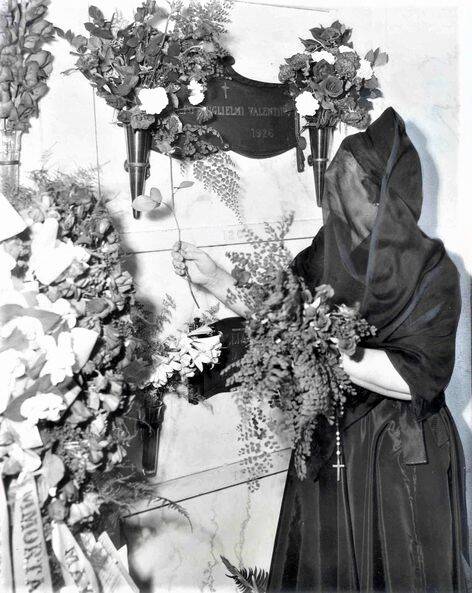
Above is one of the many mysterious Ladies in Black who have visited Rudolph Valentino’s crypt over the past century.
Add comment
Comments
Thanks for this article about Rudy. I discovered Rudy during Covid-19 on YouTube. I never was a great fan of Silent Film with the exception of The Crowd by King Vidor. I’ve been into film history since 1973 and I knew about Rudy but only by photographs, which I didn’t find very interesting. Seeing him on YouTube however, the completely natural way he acted, getting into the skin of the characters he portrayed was a revelation to me. Also his way of making love in the films that are still available, the passion, the sincerity, the ease with which he made it all so believable and thrilling is in my opinion still unparalelled today. One can read his mind from the expression on his face, however subtle, by the way he moves and the use of his hands. His smile is so very attractive as if the sun is coming up. I really think he’s the greatest romantic actor ever. His beauty is also much better conveyed by film than just by photographs. He will always remain exceptional as young people can discover him today via YouTube. In all his films his acting was superb and he shows great versatility. He was very good in dramatic roles and also in comedy. Of course like any other actor he was at his best with a good script, a good director and good fellow cast-members. I love The Four Horsemen of the Apocalypse best, followed by Blood and Sand, The Eagle and Son of the Sheik.
How very poignant on the upcoming anniversary of his passing that this well-written article serves as a reminder time may of passed but many of his fans still feel the same way about him now...