

Hollywood has always been a place of monuments, both real and imagined. Some are cast in bronze, stone, and concrete. Others remain sketches, proposals and dreams. One of the most intriguing of the latter was an ambitious plan during the 1980s to erect an enormous memorial to James Dean inside Hollywood Memorial Park Cemetery—today Hollywood Forever.
By Allan R. Ellenberger

The idea was audacious even by Hollywood standards: a towering statue of Dean, covered in gold leaf, backed by three polished granite columns representing his three starring films, with a time capsule buried beneath. It was intended to be a permanent shrine to the actor whose death on September 30, 1955, had frozen him forever at twenty-four. Instead, the monument became another unfinished Hollywood story.
Nearly three decades after Dean’s fatal automobile crash near Cholame, California, his popularity had not diminished. If anything, his legend had grown. New generations discovered East of Eden, Rebel Without a Cause and Giant on television and in revival theaters, while admirers continued making pilgrimages to his grave in Fairmount, Indiana. His image had become shorthand for restless youth, vulnerability and rebellion.
Into this atmosphere stepped Bill Dakota, a flamboyant Hollywood writer, publisher and boulevard personality. Dakota had worked for actor Nick Adams and published the gossip tabloid Hollywood Star.
He later recalled establishing a James Dean Memorial Foundation in Hollywood specifically to create a permanent statue of Dean. Dakota wanted the memorial in Hollywood Memorial Park, not in Indiana. The proposed location was particularly dramatic: near the massive Douglas Fairbanks monument, placing Dean symbolically among the great figures of Hollywood history. The project's history describes Dakota’s vision as an attempt to give Hollywood its own shrine to the actor it had transformed into a star. But a complication already surrounded the Dean name.
Dean’s family had been involved in preserving and controlling his legacy almost from the time of his death. In June 1984, his heirs formally established the James Dean Trust in Indiana and retained Curtis Management Group as the exclusive licensing agent for Dean’s name and likeness. Court records later confirmed that arrangement. By the mid-1980s, Curtis, led by attorney Mark Roesler, was aggressively developing and protecting the commercial value of the Dean image. Licensed products ranged from clothing and hats to lamps, calendars, and collectibles. That placed Dakota’s proposed foundation on a collision course with the people legally representing Dean’s heirs.
The first serious dispute appears to have developed around 1984, when Curtis objected to Dakota using Dean’s name in fundraising. From Dakota’s point of view, a commercial licensing company was interfering with a tribute conceived by admirers. From Curtis’ position, the Dean family had newly established legal rights that needed protection. The distinction was crucial: the problem was not necessarily the idea of a monument, but who had the authority to raise money and act in James Dean’s name. The project history describes Dakota halting his campaign temporarily after Curtis intervened.

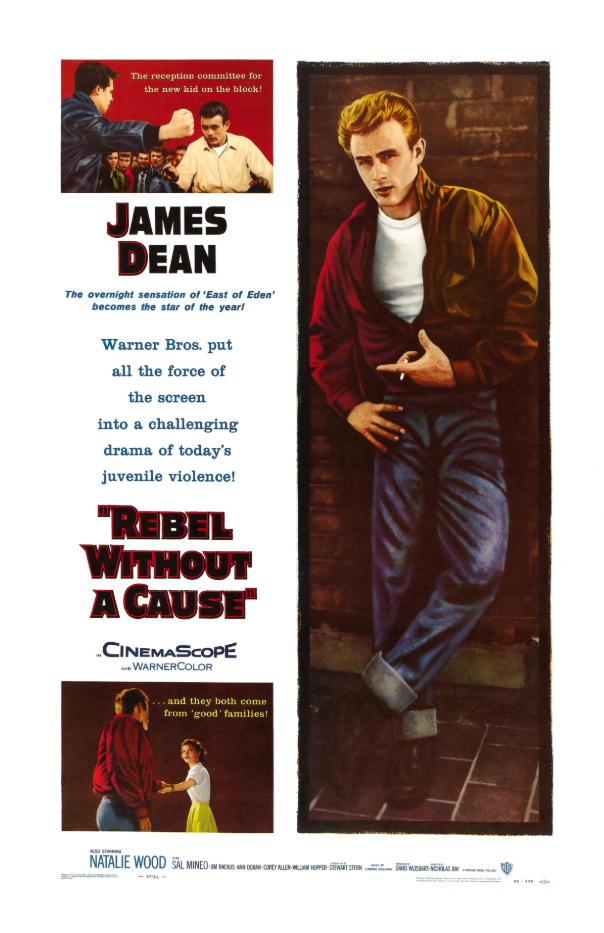

However, Dakota did not abandon the idea. By 1985, the campaign was very much alive again. Contemporary reporting confirms that his foundation was attempting to raise $200,000 for a Dean statue in a Los Angeles cemetery. That September, as Hollywood commemorated the thirtieth anniversary of Dean’s death, Mayor Tom Bradley proclaimed James Dean Day in Los Angeles, and the proclamation specifically mentioned Dakota’s proposed memorial.
The following year, the campaign became even more public. An advertisement appeared in The Hollywood Reporter calling on admirers to “Help Build Jimmy’s Memorial.” Contemporary coverage in July 1986 described the project as a $200,000 memorial planned for Hollywood Memorial Park.
And this was not going to be a modest bronze bust tucked into a garden. The proposed centerpiece was a seven-foot bronze figure of James Dean, completely covered in 23-karat gold leaf, standing on a polished black granite base bearing his name in gold. Behind him would rise three black granite columns, each symbolizing one of the three films that made Dean immortal: East of Eden, Rebel Without a Cause, and Giant. Beneath the memorial would be a time capsule containing Dean memorabilia. The projected cost was estimated at $200,000—an extraordinary sum for a privately funded celebrity monument at the time.
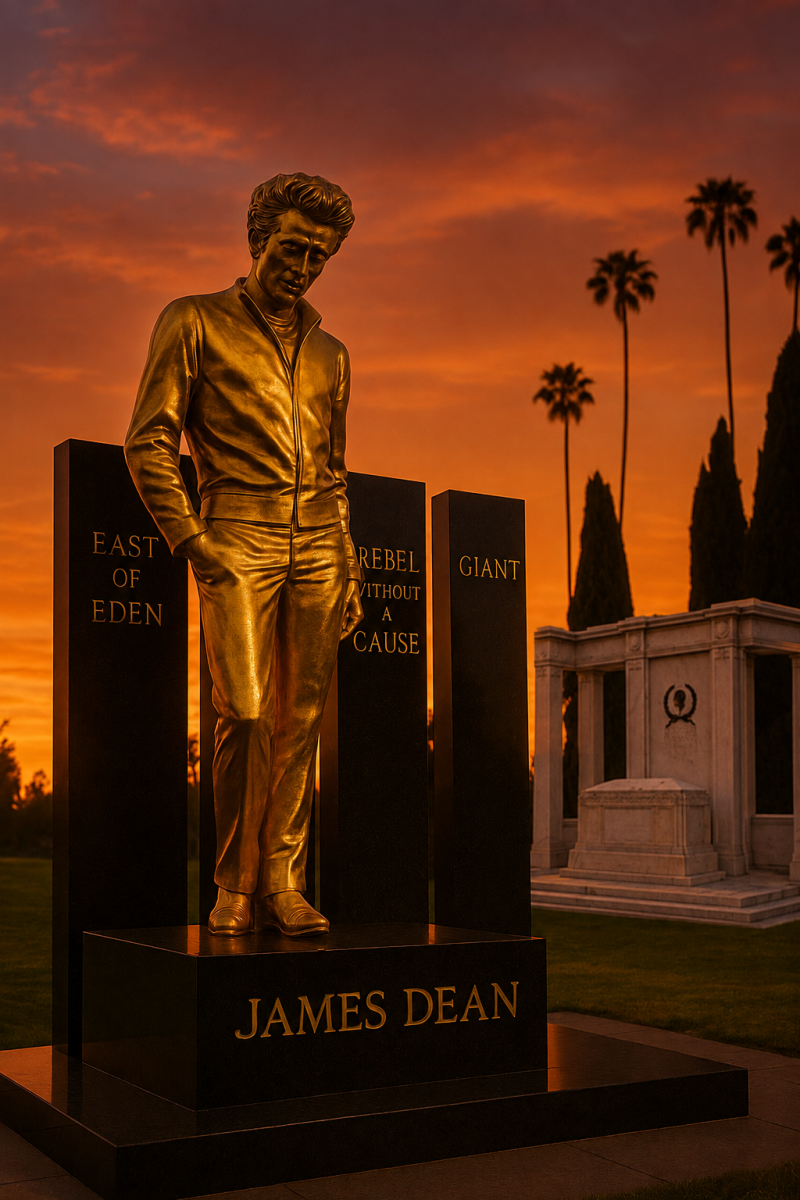
Above is an artist’s rendering of the proposed James Dean monument at Hollywood Memorial Park, created from the original description of the unbuilt memorial: a gold-leaf figure of Dean before three black granite columns symbolizing East of Eden, Rebel Without a Cause, and Giant.
The concepts description with the project gives an idea of the intended effect. Dean appears alone in gold against severe black columns, youthful and slightly bowed, the familiar figure transformed into something closer to a secular saint. The design was theatrical, solemn and unapologetically extravagant. Support came from people with genuine connections to Dean.
According to reports, Burt Reynolds contributed $1,000. Jane Deacy, Dean’s influential New York agent, supported the effort, as did Dick Clayton, the Hollywood agent who helped guide Dean after he arrived in California. An anonymous supporter reportedly made another substantial donation. Deacy’s importance to Dean’s career was enormous; she had represented him in New York and helped move him toward the opportunities that ultimately brought him to Hollywood. Clayton likewise became Dean’s West Coast representative when Deacy had no Los Angeles office.
Perhaps the most evocative supporter was Eartha Kitt, who had known Dean personally. She agreed to perform at a fundraising concert planned for September, lending the project both celebrity and emotional weight. For a moment, it appeared the monument might actually happen. Then the dispute with Curtis erupted again.
Roesler publicly maintained that he did not oppose a Hollywood statue to James Dean. According to the project documentation, he said Dean certainly deserved one. His objections centered instead on the fundraising organization calling itself the James Dean Memorial Foundation, because Dean’s family already had an organization using a similar name, and on questions about how funds were being collected and administered.
Dakota interpreted the intervention very differently. He believed Curtis was attempting to kill his memorial. Years later he continued to say that Curtis had sued him and that he abandoned the legal fight because defending himself was costing thousands of dollars. He remained bitter that a company making money from the Dean image had not itself financed the monument he believed Dean deserved.
The quarrel became increasingly personal. Roesler pointed to Dakota’s reputation as publisher of a Hollywood scandal sheet and referred to Dakota sometimes promoting his publication while dressed in drag. In the social climate of the 1980s, such remarks could easily be used to portray Dakota as an eccentric outsider rather than the organizer of a serious charitable undertaking. The press reports describe the resulting controversy as a public-relations disaster from which the monument never recovered.
By 1987, the campaign had essentially disappeared. No seven-foot golden Dean appeared near Douglas Fairbanks. No three granite columns rose over Hollywood Memorial Park. The time capsule was never sealed beneath the cemetery lawn. Dakota made no successful effort to revive the plan, and the project gradually slipped from public memory.
Dean, of course, did receive other monuments. Sculptor Kenneth Kendall’s memorial bust eventually found a home at Griffith Observatory, overlooking one of the locations closely associated with Rebel Without a Cause. His grave in Fairmount remains a pilgrimage destination, and another memorial marks the region near the California intersection where he died. But Hollywood itself never received the extravagant cemetery shrine Dakota imagined.
There is something strangely appropriate about that. James Dean’s cultural identity has always rested partly on incompletion—a career of only three starring films, a life ended before anyone could know what direction it might have taken. The Hollywood Memorial Park monument became another unfinished chapter.
Today Hollywood Forever is celebrated precisely for the mixture Dakota anticipated: cemetery, historical landmark and gathering place for people fascinated by Hollywood’s past. Had his memorial been completed, a gold-leaf James Dean might now be one of its most photographed monuments.

Sculptor Kenneth Kendall’s memorial bust of James Dean has a permanent home at Griffith Observatory, overlooking a location forever associated with Rebel Without a Cause.
Instead, it survives only in newspaper accounts, fundraising appeals, memories and imagined renderings. The monument that was supposed to make James Dean permanent in Hollywood became something very Dean-like itself: ambitious, controversial, briefly dazzling—and unfinished.
If you enjoyed my look at the James Dean monument that was once proposed for Hollywood Memorial Park Cemetery, please take a moment to comment, rate the post, and share it with others who enjoy Hollywood history, James Dean, and the stories behind the landmarks that almost became part of the city. Your support helps keep these forgotten chapters of Hollywood history alive and introduces them to new readers.
Add comment
Comments