

Few Hollywood tales have been told—or mis-told—quite as often as the story of Lana Turner’s discovery. For years, legend had it that a soda jerk at Schwab’s Drug Store spotted the eighteen-year-old beauty behind the counter and called her fame to the screen. It’s a great story, too irresistible to researchers for inclusion in just about any account of Turner’s career. The trouble is, it just isn’t true. Nearly as dramatic was what happened a few blocks away at an infinitely less glamorous and famous establishment called Top’s Café on Sunset Boulevard.
By Allan R. Ellenberger

The true story begins on January 29, 1937, when Lana was still Julia Jean Turner, but known to friends as Judy. Born on February 8, 1921, in Wallace, Idaho, Judy lived her early childhood miles away from the hills and glamour of Southern California. Her family life was filled with hardship and an unstable home life. Her father, John Virgil Turner, was a miner and gambler. When Judy was nine years old, he was shot and killed during a card game. That tragedy led her mother, Mildred Turner, to move frequently looking for work. Eventually she settled in Los Angeles during the height of the Great Depression.
By the mid-1930s the Turners were living modestly in Hollywood. Lana attended Hollywood High School, one of the city's most storied campuses and already famous for its proximity to the movie industry. As with many teenagers of the day Lana split her time between academics and hanging out on nearby Hollywood streets with her friends. Sunset Boulevard was particularly popular as it was lined with cafés, soda fountains, and small specialty stores frequented by students.
One afternoon in January 1937, the sixteen-year-old Judy slipped out of her typing class at Hollywood High and crossed Sunset Boulevard with several friends to share a Coca-Cola at Top’s Café, a small soda fountain that catered to neighborhood students. The café was located at 6750 Sunset Boulevard, catty-corner to the school and had become a popular teenage hangout.
Meanwhile, Billy Wilkerson was sitting at the next table. Wilkerson was a mover and shaker in the entertainment industry. Already the founder and publisher of The Hollywood Reporter, Wilkerson ran in producer, agent and studio executive circles. He often visited the café while taking breaks from his nearby office.
When Lana entered the establishment, Wilkerson immediately noticed her. Even as a teenager she possessed the striking features and natural charisma that would later define her film career. According to accounts recorded years later by Wilkerson’s son, the publisher was struck by the young girl’s beauty and presence the moment she walked through the door.

Billy Wilkerson, founder of The Hollywood Reporter, who discovered Lana Turner at Top's Cafe
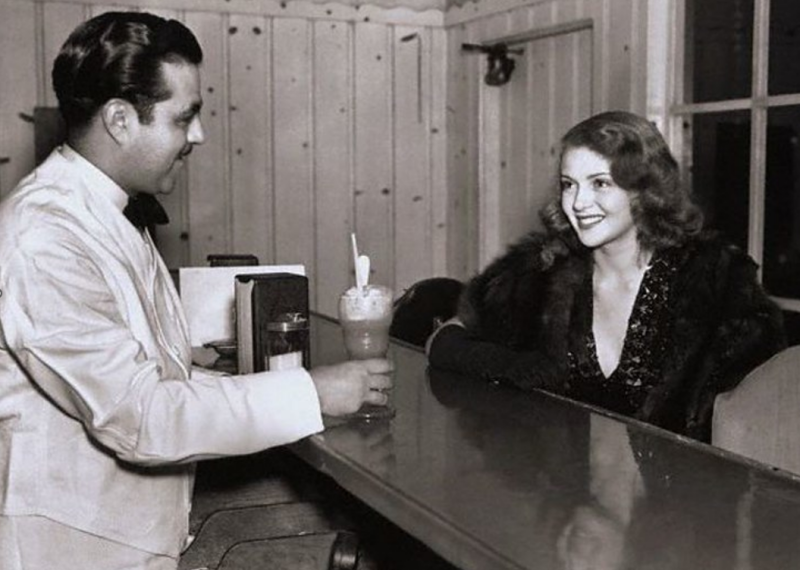
Manuel Hernandez serves Lana Turner a soda at the Top's Cafe, one year after she was discovered there by Billy Wilkerson.

The offices of The Hollywood Reporter, 6715 Sunset Boulevard, where Lana and her mother met Wilkerson, who persuaded her to pursue a career in films.
Wilkerson asked the café manager about the girl. The reply came quickly: “That’s Judy Turner.”
Intrigued, Wilkerson asked if he might meet her. The manager approached Judy and explained that a gentleman at another table wished to speak with her. Unsure of the situation, the teenage student hesitated but agreed to the introduction.
When she approached Wilkerson’s table, he presented his business card and asked a simple question: would she be interested in appearing in motion pictures? The proposition surprised and confused her. Lana reportedly replied that she would have to ask her mother before considering such an offer.
Several days later Lana returned, this time bringing her mother along. They arrived at Wilkerson's office, where he told them again how he thought the child had potential to be a great star. Beauty, innocence, and budding sensuality, what he had witnessed at the soda fountain could be captured by the motion-picture camera.
Wilkerson quickly contacted Zeppo Marx, who by that time had left the famous Marx Brothers act and established himself as a Hollywood talent agent. Marx signed the young actress to his agency, and the process of transforming Judy Turner into Lana Turner soon began.
The prediction proved prophetic. Under her new professional name—Lana Turner—she was soon signed by a major studio. Her early screen appearance in They Won’t Forget (1937) introduced audiences to what would become known as the “sweater girl,” a role that immediately made her one of Hollywood’s most talked-about newcomers.
Yet even as her career blossomed, confusion about her discovery began spreading. Another famous Sunset Boulevard landmark, Schwab’s Drug Store, soon entered the story. Located several blocks west of Hollywood High School, Schwab’s was already a popular meeting place for film industry figures and aspiring actors.

Lana Turner in a scene from her first film, They Won't Forget (1937)
The myth gained traction in the late 1930s and 1940s when Hollywood columnist Sidney Skolsky began repeating the tale that Lana Turner had been discovered there. In his version, she was spotted sitting at the soda fountain by director Mervyn LeRoy, who promptly offered her a film opportunity.
The Schwab's story had all the elements of Hollywood mythmaking--a glittering backdrop, a celebrity director, and a rags-to-riches tale of an anonymous schoolgirl transformed into a movie star overnight. It captured the public's attention and was soon featured in magazines, newspaper columns and later, film histories.
But the details did not withstand scrutiny. The original discovery had nothing to do with Schwab’s Drug Store. It had occurred at Top’s Café, and the man responsible was Billy Wilkerson, not Mervyn LeRoy.

The confusion persisted partly because Top’s Café eventually disappeared, while Schwab’s Drug Store remained a well-known Hollywood landmark for decades. As time passed, the easier and more colorful story replaced the accurate one.
Ironically, the popularity of the legend even led some to reinterpret Wilkerson’s role in the discovery. Some versions suggested that Wilkerson merely noticed the young actress while others claimed she had been spotted independently by studio figures. Yet accounts and family recollections consistently pointed back to the same moment in January 1937 when the teenage girl from Hollywood High walked into Top’s Café.
The café became part of Hollywood lore itself. The owner went so far as installing a brass plaque denoting the stool on which Lana Turner had sat when discovered. For a while, its legendary status turned the humble soda fountain into something of a tourist trap. Hollywood hopefuls and curious passersby came with the expectation of catching a glimpse of a star being born.
By January 1939, however, Top’s Café was closed, leaving Schwab’s Drug Store as the more visible symbol of Hollywood’s discovery legends. The myth became so entrenched that many biographies repeated it without question.
Still, it's an indisputable fact. Lana Turner was discovered not rifling through racks at Schwab's but at a soda fountain across from Hollywood High School the day a sixteen-year-old girl ditched class to get a Coke with her friends. There's now a Chick-fil-A fast food joint where it all happened.
From that simple moment emerged one of the most enduring stars of the Golden Age of Hollywood. Lana Turner would go on to become one of MGM’s most glamorous leading ladies, starring in films such as The Postman Always Rings Twice, Peyton Place, and dozens of other productions that cemented her place in cinema history.
But the real beginning of her story—the moment when Hollywood first noticed her—remains rooted in that ordinary afternoon in 1937, when Billy Wilkerson looked across a café and saw what the rest of the world would soon discover: a star waiting to happen.

The former site of the Top's Cafe is now a Chick-fil-A
Have thoughts on how Hollywood truly discovered Lana Turner—comment, rate, and share.

Add comment
Comments