

Few films carry the weight of tragedy quite like Brainstorm (1983). Intended to be remembered as one of the biggest and most visionary science-fiction productions of its time, it would instead become best known for the death of lead actress Natalie Wood. Even today, nearly forty-three years after its release, Brainstorm endures as something of a Hollywood curiosity. Technologically advanced, critically acclaimed by many, a box-office flop, and rarely spoken of in the same sentences as "best science-fiction movies," Brainstorm lives in the memories of most as something that happened off-screen.
By Allan R. Ellenberger
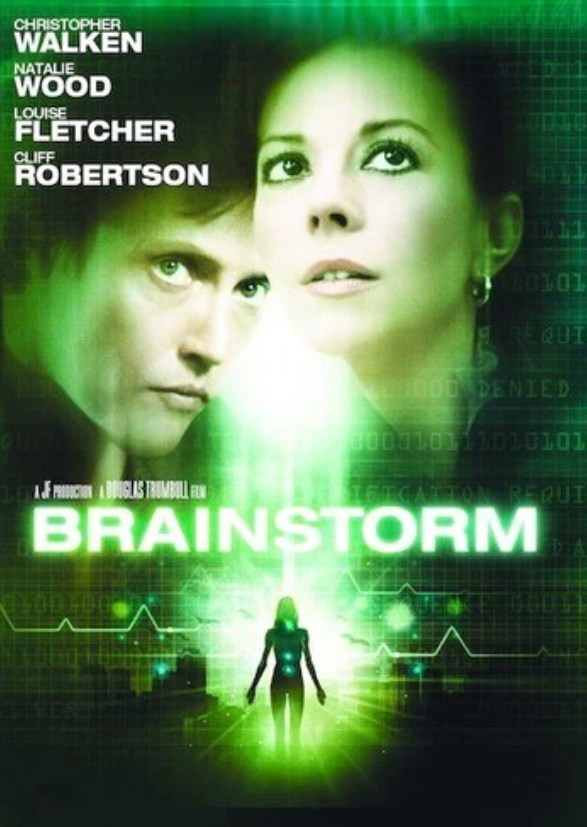
Originally based on a story by Oscar-winning writer Bruce Joel Rubin (for Ghost, 1990), the film explores questions about life. Questions of consciousness, memory, death, and living another person's consciousness intrigued him. His idea was about a device that could record everything a person sees, hears, feels, and experiences, which could then be downloaded and experienced by someone else. The science fiction would not be about spaceships or extraterrestrial life-forms, but about the inner mind.
Douglas Trumbull, one of Hollywood's most esteemed visual-effects pioneers, took an interest in the material. Trumbull had worked on some of the most iconic images in movie history, including 2001: A Space Odyssey (1968), Close Encounters of the Third Kind (1977), and Blade Runner (1982). While best known for his work in special effects, Trumbull had long harbored desires to direct his own film. With Brainstorm, Trumbull would have the chance to merge his technical visual expertise with lofty concepts of life, death, and the human experience.
The filmmakers secured a quality cast for the picture. Christopher Walken starred as Dr. Michael Brace, a talented inventor whose work has torn him apart from his wife, Karen, played by Natalie Wood. Louise Fletcher, who had starred in One Flew Over the Cuckoo's Nest and won an Academy Award for her performance, took on the role of Dr. Lillian Reynolds, a researcher who becomes emotionally attached to her work and who provides the heart of the film. Completing the main cast was veteran actor Cliff Robertson.
Scientists have created a machine that records and plays back human experiences directly from the brain. Initially, it appears to be a miracle device. Those who use it can live through another person's memories, feelings, pleasures, fears, and physical sensations. However, as with so many sci-fi stories, the darker side of this technology soon becomes apparent. It can be used for military purposes. Families fall apart. But nothing can prepare them for when Dr. Reynolds decides to record her own death from a heart attack. What she discovers challenges her understanding of life and possibly what lies after.
For Trumbull, Brainstorm became a place for visual experimentation. He wanted viewers to feel like they were experiencing someone else's thought processes. To achieve this goal, he used photographic techniques that alternated between traditional widescreen and bombastic, immersive scenes. Originally, Trumbull wanted to shoot the entire film using a new technique known as Showscan, which would project 70mm film at sixty frames per second, doubling normal film speed. This would result in a shocking clarity and realism never before seen. Theater owners refused to foot the bill for a new projector, so Trumbull had to scale back his vision. However, the completed film still featured innovative large-format photography and visual effects that enhanced the recorded experiences with a hyper-real intensity. According to Trumbull, he wanted the mindscape to feel more real than reality itself. Then tragedy befell the production.


On November 29, 1981, Natalie Wood drowned during a weekend break from filming while aboard the yacht Splendor off Catalina Island. Her husband, Robert Wagner, and Brainstorm costar Christopher Walken were also on board. She was only forty-three years old. Her death instantly became Hollywood's greatest mystery, spawning decades of speculation, investigations, documentaries, books, and headlines.
Production halted instantly. MGM was faced with some tough choices. Rumor was that they wanted to scrap the project entirely and take their insurance payout instead of continuing to sink funds into a suddenly tragic movie. Trumbull pushed back hard on that decision. He felt the movie could not only be finished but should be, to satisfy artistic goals and do right by Wood's legacy. He later revealed that continuing the movie was one of the most draining experiences he's ever had.
This became even more complicated when Wood had not yet filmed all of her scenes. Trumbull and company were forced to reshoot parts of the film, edit out some elements, and improvise around Wood's missing appearances. Stand-ins were used when necessary, shots were edited together from footage of sound- alike actresses, and Trumbull received assistance from Wood's sister, Lana Wood, to cover some of the scenes she was absent from. Luckily, Wood filmed most of her key scenes prior to dropping out of the film. Because of this, her performance could remain mostly intact.
For almost two years, Brainstorm's fate hung in the balance. Lloyds of London brokered a bizarre financing deal to fund finishing, and Trumbull crossed the finish line. Released in September 1983, almost two years after Wood's death, Brainstorm premiered and was dedicated to her memory.
Critics, finally seeing the picture, tended to respond favorably to its scope. Critics lauded the film for its visual flair, technical creativity, and its address of heady concepts. Louise Fletcher garnered high praise for her performance, and critics felt Natalie Wood turned in a complete performance, given the film's tumultuous shooting. Transitions between reality and recorded consciousness were praised as the film's technical highlights.

Above: Natalie Wood and husband Robert Wagner aboard the yacht Splendour off California's Catalina Island from where the actress met her tragic death in November 1981. Below: Director Douglas Trumbull confers with Natalie Wood during the filming of Brainstorm (1983), the science-fiction drama that became her final motion picture.

The film was certainly not overlooked by award-giving bodies. Brainstorm earned several nominations at the Saturn Awards. Amongst them were Best Science Fiction Film, Best Director, and Best Special Effects. Louise Fletcher took home the award for Best Actress. The eerie musical score composed by James Horner won Best Music. Natalie Wood was nominated posthumously for Best Supporting Actress.
But even with positive reviews and impressive creative talent behind it, Brainstorm never reached blockbuster status as many had anticipated. One reason may be that it came out around the same time that numerous viewer-friendly science-fiction flicks were released in the early 80s, such as E.T. the Extra-Terrestrial and Return of the Jedi. By comparison, Brainstorm was more subtle, thoughtful, and emotionally nuanced. It challenged its audience to think about mortality, remembrance, and awareness.
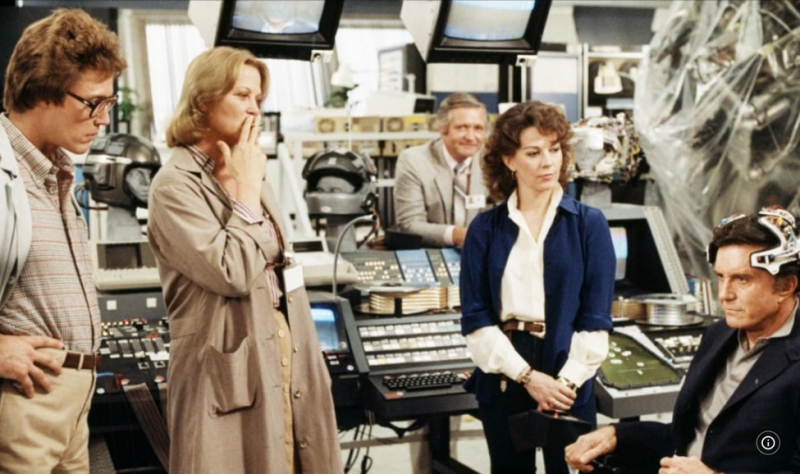
The principal cast of Brainstorm (1983): from left, Christopher Walken, Louise Fletcher, Natalie Wood, and Cliff Robertson. Between them, the quartet brought a remarkable eleven Academy Award nominations and three Oscar wins to Douglas Trumbull's ambitious science-fiction drama.
Of course, Natalie Wood's death also overshadows the film. Much of the publicity surrounding Brainstorm centered on the tragedy. Those who saw Brainstorm went less for a science-fiction film and more for "Natalie Wood's last film." Even today, any reference to Brainstorm starts with her death. What about the film itself makes people forget about it?
The answer may be that it sits awkwardly between categories. It's not a big blockbuster spectacle like Star Wars. It's not a cult classic like Blade Runner. It's not horror, or romance, or a straight-up thriller. Its concepts of virtual reality, memory downloads, and total sensory immersion were way ahead of its time, but they arrived before audiences were fully prepared to embrace them.

Director Douglas Trumbull guides Natalie Wood through a scene from Brainstorm (1983), the groundbreaking science-fiction film that would ultimately become the beloved actress's final screen appearance.
Ironically, Brainstorm may hold more appeal today than it did when released in 1983. Today, we have virtual reality goggles, brain chips, computers that think, and digitized consciousness. The central concept of Brainstorm isn't as far-fetched as it may have seemed forty-three years ago. Can you relive someone else's experiences?
There's also no way to watch this movie without thinking about the tragic story behind its production. Natalie Wood's untimely passing remains one of Hollywood's biggest tragedies to date, and Brainstorm effectively became the vehicle that brought that tragedy into pop culture. Oftentimes, it now exists more in people's minds as a footnote to her life than as an actual sci-fi movie.
Most significant of all, perhaps, the controversy around Brainstorm prompted Douglas Trumbull to abandon directing Hollywood movies. While he continued to work as a visual-effects legend, he eventually stated that the troubled production and the circumstances surrounding Natalie Wood's death left him without the appetite to direct another studio film. Brainstorm would be his last Hollywood directorial feature.
That is unfortunate. Brainstorm might not be a perfect movie, but it's one of the most interesting and ambitious science-fiction films of the 1980s. It's a film about memory, consciousness, and mortality that became inextricably linked to an all-too-real loss. Maybe that's why it lives on in the minds of those who encounter it. Like the machine at the film's core, Brainstorm captures a final performance, a final moment, and a final look at a beloved star who left us far too soon.
Coming tomorrow to The Hollywoodland Revue: the remarkable story of Mae Dix, the vaudeville performer and exotic dancer long credited with introducing the striptease to America. Discover her fascinating life, career, and final resting place at Hollywood Forever Cemetery. Don't miss it!
If you enjoyed my look behind the scenes of Brainstorm and the remarkable story of how the film overcame tragedy, groundbreaking technology, and enormous challenges to reach the screen, please leave a comment, rate the article, and share it with fellow classic film fans.
Add comment
Comments