

Before the Academy Award became that locked down, tracked and sacred cultural trophy, it was just a thing. Honorific. Symbolic. Sometimes achingly fragile. Perhaps no lost Oscar underscores this better than Hattie McDaniel's Missing Oscar. Gone With the Wind's Oscar plaque vanished without a trace. It was not the iconic golden statuette we know and love now, but the precursor plaques awarded to supporting actors (and actresses) during that period in time. It was history being made...and then it went mysteriously missing.
By Allan R. Ellenberger

Few moments have carried more weight than Hattie McDaniel’s win at the Academy Awards ceremony in February 1940. McDaniel became the first Black performer to earn not only a competitive Academy Award nomination but to win the award itself, receiving the Oscar for her portrayal of Mammy in Gone With the Wind. However, her moment of triumph took place within a rigidly segregated industry. That year’s ceremony was hosted at the Cocoanut Grove inside Los Angeles’s Ambassador Hotel. Hotel management allowed McDaniel to attend only after special requests. They seated her away from the rest of the film’s cast and producers at a small table along the wall.
The award she won that night was consistent with the Academy’s initial tradition. Accompanying actor winners were not awarded statuettes, but rather rectangular plaques affixed to black pedestals with the Academy seal embedded within it, alongside a smaller version of Oscar.
It made a difference. Plaques were less bulky. They were portable. And, eventually, they were easier to lose sight of. McDaniel graciously accepted her award, treading carefully between thanking everyone in sight and what could not be said aloud about what it meant to be her. She hoped that she had “always been a credit to my race.” Visibility. Alone.
Over subsequent years, McDaniel remained busy, but she still faced limitations on the roles Hollywood would allow her to play. As McDaniel became ill in the early 1950s, she decided she did not want her Academy Award to become a memorial asset for her estate. Instead, she wanted it given to historically black Howard University in Washington, D.C., where it could be a "certificate of achievement" for students shut out of Hollywood decision-making. She left instructions for her lawyer to donate her Oscar plaque to the university's drama department. In various reports, it has been noted that the Oscar trophy sat on display for years at Howard.
Then, sometime in the late 1960s or early 1970s, it vanished.
It wasn't announced. No record exists of its transfer. Nothing documents its removal. One day, the plaque was there and suddenly it was gone. Circumstances surrounding its disappearance have been debated ever since. Howard University and campuses around the country were in turmoil during that era. Amid student protests and administrative shake-ups, offices and collections were moved or renovated overnight. Stuff got moved around quickly and few records were kept on pieces that weren't felt essential to the school's survival. By the time anyone questioned its absence, no one could pinpoint exactly when or how it had disappeared from the building. From that silence, theories multiplied.

Hattie McDaniel arriving at the Academy Awards ceremony at the Cocoanut Grove, poised and radiant on Hollywood’s most celebrated night.

Hattie McDaniel accepting her Academy Award, a historic moment that forever changed the face of Hollywood.

Hattie McDaniel, left, poses for a publicity photograph holding a standard Academy Award statuette, which actress Fay Bainter, right, presents to her rather than the plaque McDaniel actually received.
Another rumor points to political motivation behind the loss, suggesting that the plaque was either thrown away or destroyed during racial unrest because protesters did not want to be reminded of subservient positions and hollow victory. Some accounts take it even further, suggesting that it was thrown into the Potomac River or destroyed out of rage. While there is a strong sentiment behind these explanations that tie up the loss of the object with the rage felt during the time period in which it went missing, they have never been proven and remain unsubstantiated.
Less dramatic theories are quieter, and far more plausible. The plaque might have been lost during a move. Someone may have packed it into storage without labeling it or removed it from its accession records. After all, compared with a statuette, a plaque doesn't scream "That's an Oscar." Stored in the ever-shifting milieu of an institution, it might have been put in a box, put on a shelf, filed under some innocuous name and forgotten. Curiously, some university officials complained years later that they could not locate paperwork proving they ever received the award. That mystery may have simply been bureaucratic.
There is also the possibility of outright theft. Before the Academy imposed strict controls over Oscar ownership, awards could and did slip into private hands. The monetary value of such objects increased dramatically over time, and a plaque—especially one associated with a historic “first”—would have been irresistible to a collector. Yet no Brady-style resurfacing ever occurred. No plaque bearing McDaniel’s name has appeared at auction or in a private collection. If it was stolen, it vanished completely.
What’s hurtful about losing it is not that another Oscar was lost, but that this Oscar was lost. McDaniel’s plaque represented more than just recognition from her industry. It served as tangible evidence of the rare moment Hollywood widened a door it had long been keeping closed. At Howard University, that award went from being a mere trophy to a lesson. A lesson that you could still achieve greatness, even when it tried to smother you with limitations. And when that plaque disappeared, so did that lesson.
Years passed. Decades passed. The Academy acknowledged the loss but could not account for it. Howard University said they couldn’t find it. Rumors became lore. Lore became fact. The original plaque was gone forever.

Hattie at home with her Oscar
Until, years later, the Academy made a rare and symbolic gesture. In 2023, they replaced the lost original award. Acknowledging that the original award was lost and likely unrecoverable, it commissioned a replacement plaque and formally presented it to Howard University in a ceremony appropriately named “Hattie’s Come Home.” It now resides in the Chadwick A. Boseman College of Fine Arts. Not as righting a wrong, but as acknowledging a right.

Howard University faculty members and others celebrate the presentation of Hattie McDaniel’s replacement Academy Award. Front row from left: Jacqueline Stewart, Rhea Combs, Eleanor Traylor, Phylicia Rashad and AMPAS executive Teni Melidonian. Back row: Howard University professors Khalid Long and Greg Carr flank Kevin John Goff (Photo Credit: Amanda Jones / ©Academy Museum Foundation)
Even as the new plaque replaced it, the absence remained. The substitute could memorialize, but it could not travel the road of the thing it stood in for. The night it was presented to McDaniel in the segregated ballroom, the decades spent lighting students’ way, the night it disappeared from its perch and into obscurity. The original plaque still lives somewhere—or it doesn’t. It may be concealed, shredded, discarded or dormant until discovered by someone who knows what to look for.
Hollywood has always been adept at rewriting its own narrative, smoothing over discomfort with ceremony and symbolism. But the story of Hattie McDaniel’s lost Oscar resists a clean ending. The replacement restores visibility, but not certainty. The honor has come home, yes—but the history remains fractured.
Somewhere between celebration and erasure, Hattie McDaniel’s missing gold continues to ask a question Hollywood has never fully answered: what happens to history when no one is watching closely enough to protect it?
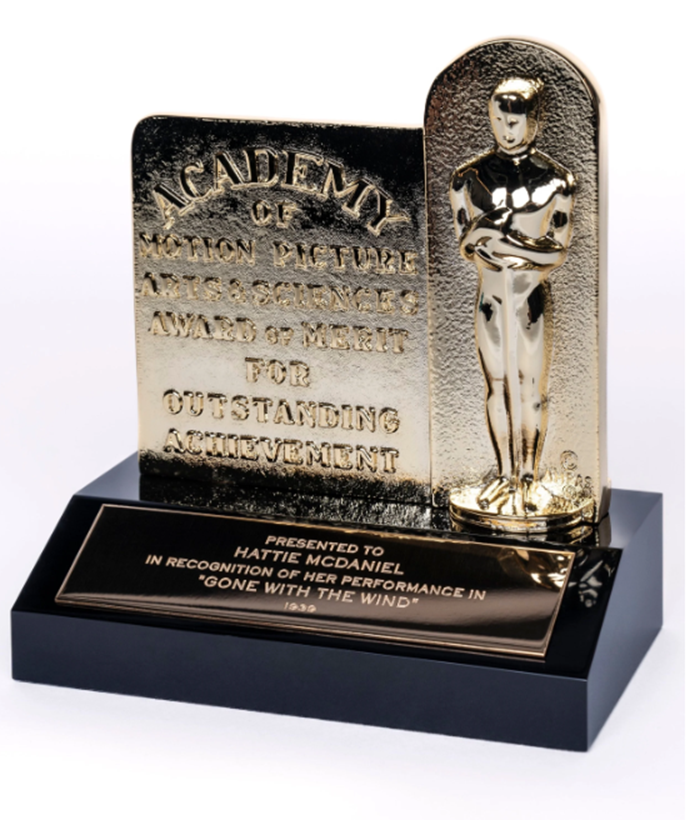
Reproduction of the original plaque of Hattie McDaniels Academy Award for Actress in a Supporting Role for Gone with the Wind (1939). (Photo Credit: ©Academy Museum Foundation, Photo by: Owen Kolasinski)
Please comment on, rate, and share the story of Hattie McDaniel’s lost Oscar to help keep this pivotal chapter of Hollywood history alive and discussed.

Add comment
Comments