

During the infancy of Hollywood and its growing motion picture industry stars were few and legends were just beginning to be made. Many bright careers would burn intensely for only a moment before going out. Unfortunately for young leading man Page Peters, his flame would go out far too early. In the summer of 1916 at the young age of twenty-seven Peters was found dead in the Pacific Ocean causing shock to spread through the film industry.
By Allan R. Ellenberger

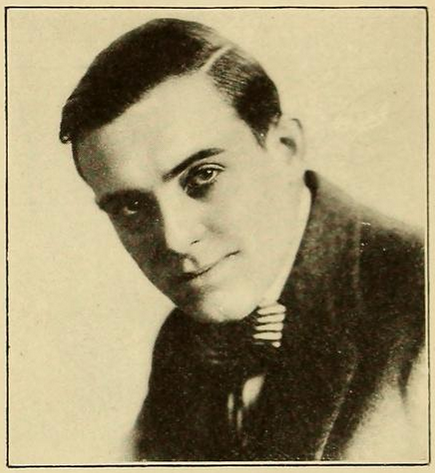
Page Peters was born in Louisville, Kentucky, the son of Dr. E. E. Peters, who was superintendent of the School for Boys at St. Charles, Illinois. Growing up under strict tutelage, Peters went on to graduate from Western Military Academy. This background helped Peters develop the physique and stature of a silent film lead. Standing tall, dark and exceedingly handsome, Peters had the features that film producers looked for in their matinee idols of the time.
Before entering films, Peters worked in a variety of occupations, including automobile sales, a field he would briefly consider returning to later in life. But the rapidly expanding motion picture industry soon drew him westward to California. By the mid-1910s he had become associated with several of the companies helping shape the young Hollywood film community.
Peters first appeared in films around 1913, and within a few years, he had become one of the better-known young actors in silent films.
Peters acted with companies headed by some of the earliest producers and directors including Jesse L. Lasky and director D. W. Griffith. Peters later worked with the Morosco-Pallas organization, one of the production companies working during the years when films were starting to be made primarily in Hollywood.
In his short career Peters appeared in many productions of note, frequently sharing scenes with many of the biggest stars of the era. Peters starred in The Gentleman from Indiana, Davy Crockett, and Ben Blair, all with Dustin Farnum, one of silent film's most popular leading men. He also starred in Pasquale with George Beban, An International Marriage with Rita Jolivet, He Fell in Love with His Wife with Florence Rockwell and Madame La Presidente starring Anna Held.
Contemporary observers often remarked upon Peters’ appearance and personality. Standing six feet tall with dark features and a commanding presence, he was frequently described as one of the most handsome men working in motion pictures. Equally important, colleagues remembered him as a well-liked and personable member of the early Hollywood community.
By 1916 Peters’ career seemed to be on the rise. After several years in films, he had begun establishing a reputation as a capable supporting player and romantic lead. Yet at the very moment when his future appeared promising, his life came to an abrupt and tragic end.
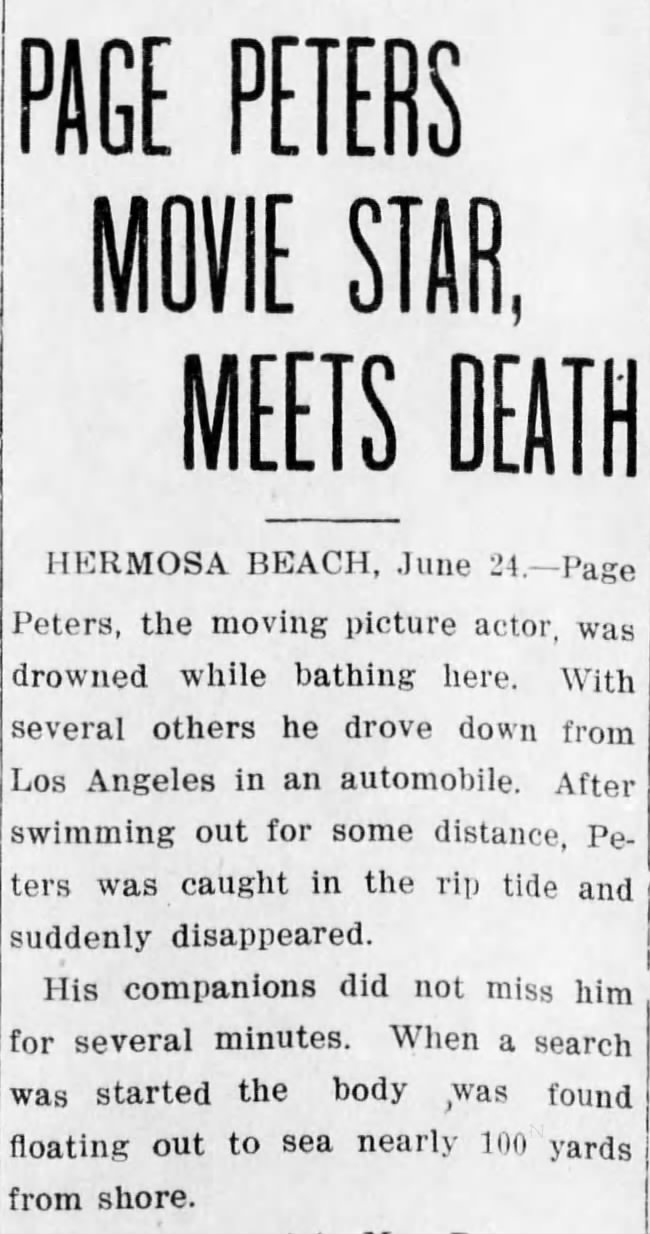
On the morning of June 22, 1916, Peters joined a group of friends for a day’s outing at Hermosa Beach, then a popular seaside retreat for residents of Los Angeles and Hollywood. The party had driven down from the city to visit the beach house of Harry Graves, located near Fourth Street and the Strand.
A number of people in the party swam in the Pacific Ocean early that morning. Peters had gone into the ocean with a woman friend, identified as Miss Graves, and they swam out ahead of others in the group. At some point, seemingly caught in a strong rip tide, Peters was abruptly gripped by panic.
Miss Graves attempted desperately to keep him afloat and shouted for help. But the struggle lasted only moments before Peters disappeared beneath the waves. His companions quickly raised the alarm, and lifeguards and nearby swimmers rushed to search the waters.
For nearly an hour and a half the ocean was combed by rescuers. Finally, as the outgoing tide shifted, Peters’ body drifted back toward shore and was discovered floating approximately one hundred feet from the beach by searchers in a motorboat.
A pulmotor—a mechanical resuscitation device commonly used in early rescue attempts—was brought from Redondo Beach. For two hours rescuers labored to revive the young actor, but their efforts proved futile. Despite the dramatic circumstances, medical examination later suggested that Peters may not have drowned at all. Less than a pint of water was found in his lungs, leading physicians to conclude that he likely suffered heart failure or collapse brought on by the strain of the swim.
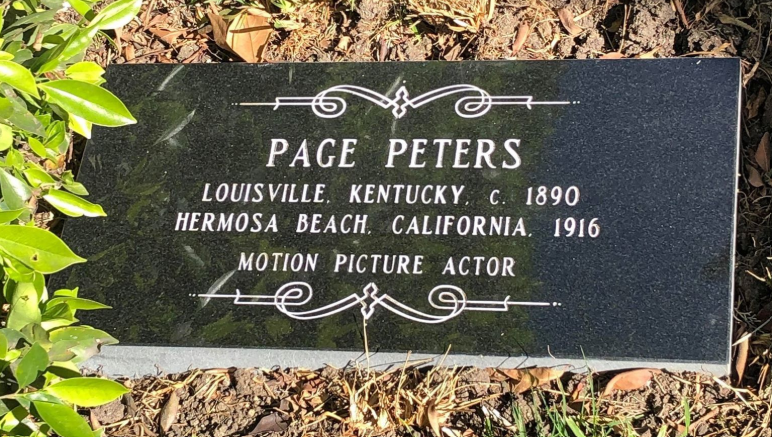
Actor Page Peters’ grave remained unmarked for nearly 104 years, until an anonymous benefactor purchased and installed the marker shown here in 2020.
The news of his death spread quickly through the motion picture community. His funeral was held a few days later at Hollywood Cemetery, in a poignant coincidence occurring exactly three years to the day after he had begun working in motion pictures. Members of the film industry served as pallbearers, including director Al Christie, Horace Davey, Ray Meyers, and Raymond Russell, who had collaborated with Peters on his first film.
In an unusual and somewhat haunting tribute, Peters’ grieving parents requested that the funeral itself be filmed. Director Al Christie and cinematographer Anton Nadge recorded the service using the same camera equipment that had captured Peters’ earliest screen appearance, preserving the final farewell to the young actor on film.
Peters was laid to rest in Section 9, Grave 428 of Hollywood Cemetery. For more than a century his grave remained unmarked, a silent reminder of how easily the pioneers of early cinema could fade from public memory. Only recently was the site finally marked through the generosity of an anonymous benefactor, restoring recognition to a performer whose life ended almost as soon as his career had begun.
Today Page Peters is one of countless forgotten individuals who helped build the foundation for what Hollywood would become. A handsome man gifted with talent, he was respected by his peers and symbolized the youth of silent cinema. He died tragically in the waters off Hermosa Beach, his death marking one of the first Hollywood tragedies and proof that celebrity was as fleeting as the current which took his life.
If you found this story of actor Page Peters compelling, please take a moment to comment, rate, and share the post to help keep his legacy remembered.
Add comment
Comments
Thank you for that tribute and history of this man. I don’t believe I’ve ever seen a movie he was in, but it always intrigues me and it’s such a sad story.