

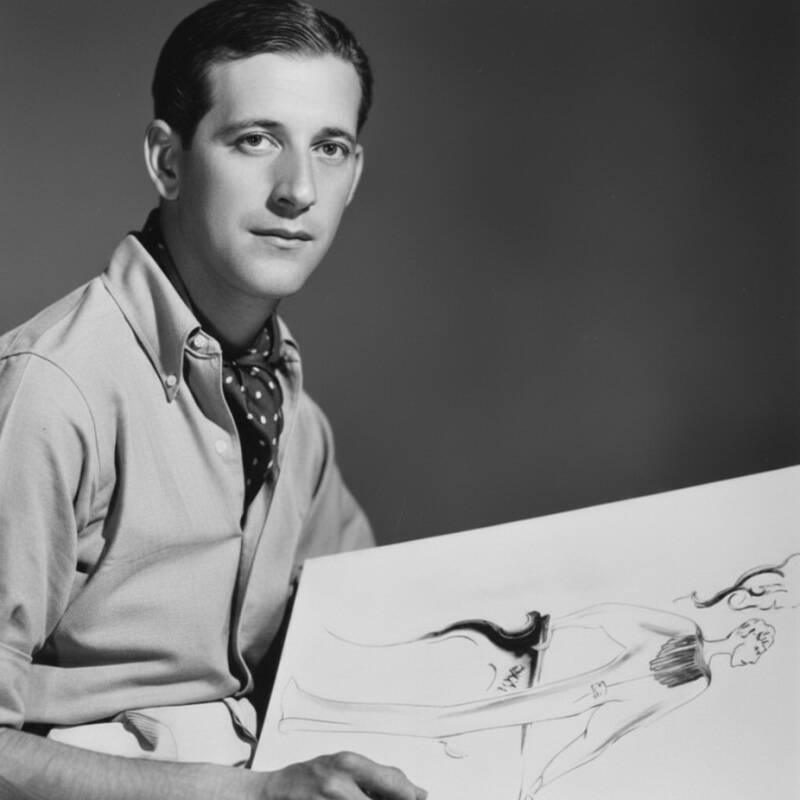
If Louis B. Mayer built the MGM dream factory, Adrian was the one who decided how it looked. More than any actor, director, or producer, Adrian shaped Hollywood glamour during its Golden Age. The broad-shouldered Joan Crawford look, Greta Garbo's sharp elegance, Jean Harlow's smooth sophistication, Katharine Hepburn's tailored style, and even Dorothy's ruby slippers in The Wizard of Oz all came from the mind of one man: Gilbert Adrian Greenburg, known simply as Adrian. For over a decade, his credit, "Gowns by Adrian," became as familiar to moviegoers as the stars themselves. Still, Adrian's story is also one of many queer stories that were visible in Hollywood but rarely spoken about openly.
By Allan R. Ellenberger

Adrian Adolph Greenburg was born on March 3, 1903, in Naugatuck, Connecticut. He grew up in a Jewish family that valued art and encouraged his creativity. His father ran a hat-making business, and both parents were artistic. As a child, Adrian showed real talent, drawing detailed pictures and designing costumes even as a teenager. Seeing his abilities, his family sent him to the Parsons School of Fine and Applied Arts in New York, and later he studied in Paris. There, his life changed when Irving Berlin saw his work and hired him to design costumes for the famous Music Box Revues.
Adrian's work on Broadway soon brought him to Hollywood. After designing for stage shows and a few silent films, he was hired by Cecil B. DeMille. When DeMille joined MGM in 1928, Adrian went with him and quickly became the studio's chief costume designer. This decision turned out to be one of the most important in Hollywood history. Over the next 13 years, Adrian designed costumes for more than 200 films and became one of the most influential costume designers in movie history.
During the Great Depression, MGM offered audiences an escape into fantasy, and Adrian understood this better than anyone. His costumes did more than dress actresses; they helped create their on-screen personalities.
Greta Garbo's mysterious distance, Joan Crawford's drive, Norma Shearer's elegance, and Jean Harlow's sensuality were all shaped by Adrian's designs. He created each wardrobe to match the image the studio wanted to show the public. Adrian's influence reached far beyond the movies. Department stores across the country rushed to copy his styles, and women everywhere bought dresses inspired by his latest creations. The famous white ruffled gown Joan Crawford wore in Letty Lynton reportedly led to hundreds of thousands of copies, making Adrian perhaps the first costume designer to shape mass-market fashion nationwide.


Adrian's extraordinary talent for creating screen glamour is showcased in the costumes he designed for, from left to right, The Eagle (1925), Mata Hari (1931), Letty Lynton (1932), and Reckless (1935), films that helped define the visual elegance of Hollywood's Golden Age.
Many consider The Wizard of Oz (1939) to be Adrian's greatest work. Judy Garland's ruby slippers are now some of the most famous costume pieces in film history. Still, Adrian often preferred his elegant designs for Garbo, Crawford, Hedy Lamarr, and Norma Shearer over the fantasy costumes that brought him lasting fame.
As Adrian became more famous, people also started to talk about his personal life. In Hollywood, many knew he was gay, though it was not discussed openly. Like many gay men in the entertainment industry at the time, Adrian had to be careful. Being openly gay could ruin a career, cause scandal, and bring unwanted attention from studio bosses. Still, Hollywood's creative community was often more accepting in private than most people realized.
Because of this, historians now look at Adrian's 1939 marriage to Academy Award-winning actress Janet Gaynor in a new way. Many call it a "lavender marriage," meaning it gave social cover to one or both partners. People in the industry widely believed Adrian was gay, and rumors about Gaynor's sexuality followed her throughout her career. Some writers think she may have been bisexual, while others say she had close emotional ties with women. There is no solid proof, and most of what is said comes from rumors and memories rather than facts. What is clear is that Adrian and Gaynor always described their marriage as happy. They stayed together until Adrian died and raised a son, Robin, born in 1940.
Their marriage is still one of the most interesting in classic Hollywood because it cannot be easily explained. Today, people often think a lavender marriage was just for show, but real relationships are rarely that simple. Adrian and Gaynor clearly cared for each other and shared respect and companionship. Only they knew whether their marriage was mostly romantic, practical, or a mix of both.

Adrian and his wife, actress Janet Gaynor. A marriage of convenience?
One rumor that has lasted for years involves Francis Lenn Taylor, an art dealer and Elizabeth Taylor's father. Some Hollywood gossip claimed Adrian and Taylor had a close relationship before Adrian got married. Still, there is little solid evidence to support this. Like many stories about closeted Hollywood figures, this rumor survives mostly through stories and retellings, not proof. Historians can mention the rumor but cannot treat it as fact.
By the early 1940s, Adrian was frustrated with MGM. Tight budgets, studio politics, and less creative freedom led him to leave the studio where he had made his name. In 1942, he opened Adrian, Ltd. in Beverly Hills and moved from costume design to fashion design. His structured suits, strong shoulders, and bold shapes influenced American fashion throughout the 1940s. In 1945, he won the Coty Fashion Award, one of the top honors in the industry.

In 1945, Adrian received the prestigious Coty American Fashion Critics' Award from former New York Mayor Fiorello La Guardia. Accepting the honor, the celebrated designer noted that such recognition carried special significance during the challenges of wartime America, calling it a "great privilege."
In the 1950s, health problems started to slow Adrian down. After years of hard work, he gradually stepped back from the fashion world, though he sometimes returned for special projects. One of his last jobs was designing costumes for the original Broadway production of Camelot. Sadly, he did not live to see the show's success.
On September 13, 1959, Adrian died of a stroke at California Hospital. He was only fifty-six. Hollywood lost not just a designer, but one of the main creators of its visual style. After his death, he was awarded the Tony for Camelot, a final honor for his remarkable career.
Adrian was buried at Hollywood Memorial Park (now Hollywood Forever), a fitting place for someone who helped create the city's dreams. Today, visitors may not know his name right away, but they know his work. Every photo of Garbo in elegant clothes, every Crawford power suit, every Harlow gown, and every glimpse of Dorothy's ruby slippers shows Adrian's touch.
During Gay Pride Month, Adrian should be remembered not just because he was likely gay, but because he stands for a whole generation of queer artists who changed American culture while not being able to speak openly about their lives. Their work was seen everywhere, even if their identities were often hidden.
Hollywood has always celebrated the stars on screen. Adrian reminds us that some of its most important creators worked behind the scenes. In many ways, he designed Hollywood's look, and nearly seventy years after his death, the dream he created still lives on.
Tomorrow on The Hollywoodland Revue: this week’s “Coming Attractions” roundup featuring the newest theatrical releases, critical reactions, audience buzz, and recommendations on what may—or may not—be worth your ticket money.

If you enjoyed my latest Hollywood Forever profile of legendary MGM costume designer Adrian, please take a moment to comment on, rate, and share the article as we celebrate the creative genius who helped define the glamour of Hollywood's Golden Age.
Add comment
Comments
This is a very well done bio and tribute!
Thanks Sandra, I appreciate the comment.