

Long before Hollywood Boulevard became crowded with tourists, before movie palaces lit up the skyline, and before Charlie Chaplin built his studio at La Brea and De Longpre, there was 1359 North La Brea Avenue. Tucked between strip malls and apartment buildings, this Craftsman home is one of the oldest still standing in Hollywood. Its story is as rich as the city’s and closely connected to its builder, Dr. William Francis “Frank” Traughber, an osteopathic physician who witnessed Hollywood’s transformation from a quiet farming area to the movie capital of the world.
By Allan R. Ellenberger

Above: 1359 North La Brea Avenue, built by Dr. William Francis Traughber, as it appeared before the widening of La Brea Avenue in 1929. (Photo courtesy of Tonya Graham McQuade.)
William Francis Traughber was born on August 29, 1874, in Centralia, Missouri, to Frank M. Traughber and Marnie Agnes Bryson. When he reached adulthood, medicine was just starting to change. He chose osteopathy, a field that was not widely accepted in 1901. Dr. Traughber graduated from the American School of Osteopathy in Kirksville, Missouri, which was founded by Dr. Andrew Taylor Still, the father of osteopathic medicine. At that time, many traditional doctors thought osteopaths were quacks, but Traughber valued treating the whole patient.

The property at 1359 North La Brea Avenue photographed in June 2026, approximately a century after its appearance in the historic image. above
His future wife, Nora Petree (1881-1970), was also from Missouri but had a different background. She grew up in Kirksville and later moved west to attend Stanford University, graduating in 1905 with a degree in English. Frank followed Nora to California that August, and they married at her brother Louis Petree’s home in San Jose. Frank and Nora were married for over forty years and had four children: Frank Leslie (1906-1996), Margaret Ruth (1909-1977), William Virgil (1910-1975), and Robert Taylor (1913-1993).
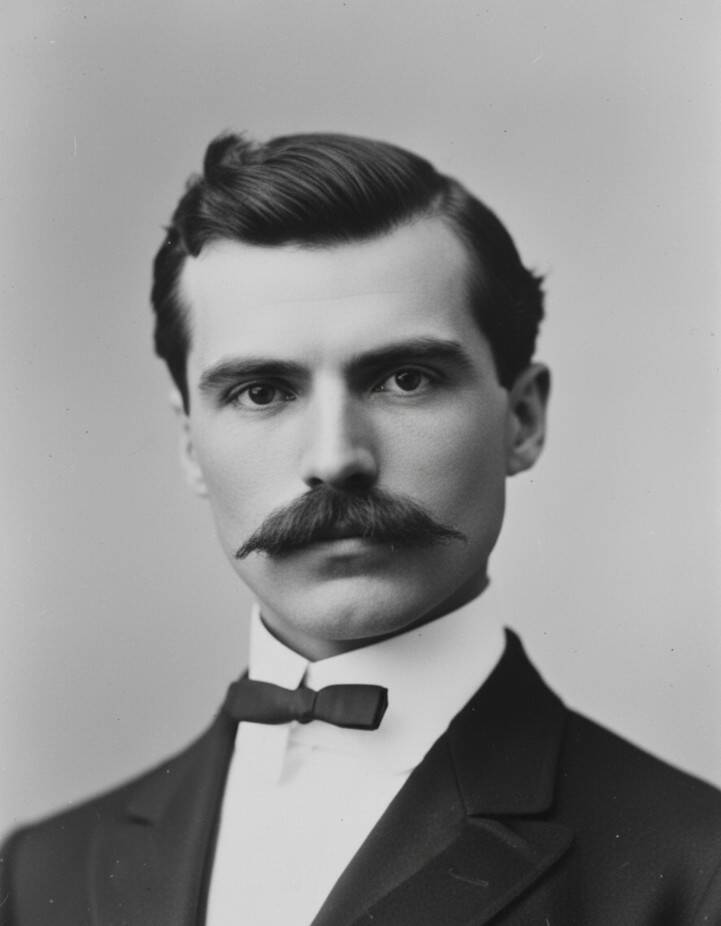
Fresh from earning his medical degree, William Francis “Frank” Traughber poses for his graduation portrait at USC's College of Physicians and Surgeons in June 1911.
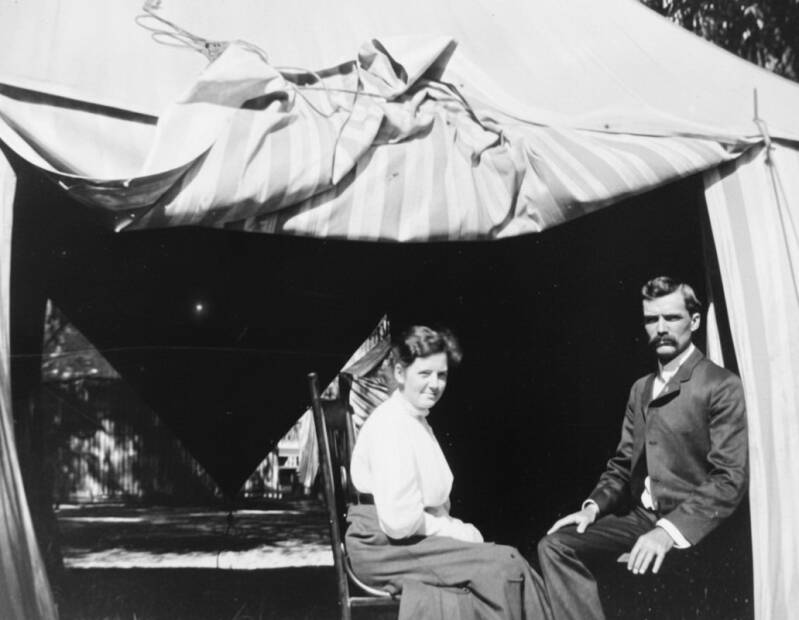
Nora and William Traughber enjoying what appears to be a vacation getaway. (Photo courtesy of Tonya Graham McQuade)
The couple spent their early married years in Mexico, Missouri, where Dr. Traughber built a successful osteopathic practice. Soon, new opportunities drew them to Southern California. By 1908, the Traughbers had moved to Los Angeles. They first lived on West Ninth Street, then moved to Adams Street. Dr. Traughber continued his medical training at the University of Southern California College of Physicians and Surgeons. He graduated on June 15, 1911, adding surgeon to his list of skills.
That same year marked the beginning of the chapter he is best known for. After graduating from USC, his family moved into a new house at 1359 North La Brea Avenue. Hollywood looked very different then, with orange and lemon groves nearby and most of the land covered in dirt roads and open fields. The film industry was just starting to take root. Hollywood’s first studio, Nestor, had opened only a few months earlier, and few people could have imagined it would become the movie capital.
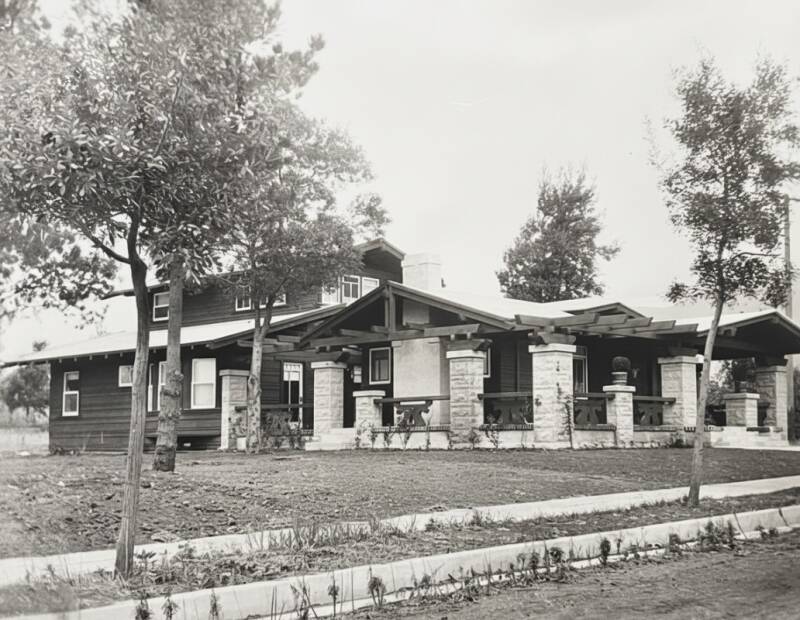
The property as it appeared before the La Brea Court bungalows were built on the adjoining parcel to the south in 1922. (Photo courtesy of Tonya Graham McQuade)
The home itself was also far from modest. The identity of its creator had been a mystery for decades until the discovery of documents linking it to the prominent architectural firm of Arthur and Alfred Heineman. Brothers Arthur and Alfred designed hundreds of bungalows throughout Southern California in the early 1900s. Sadly, only a small percentage of these stunning homes still stand. Dr. Traughber's would be a classy Craftsman home symbolizing stability and success. Palm trees dotted the front lawn of this stately home on the coveted southwest corner lot at La Brea and De Longpre. One hundred plus years later, this home is one of the last physical pieces of residential Hollywood left.
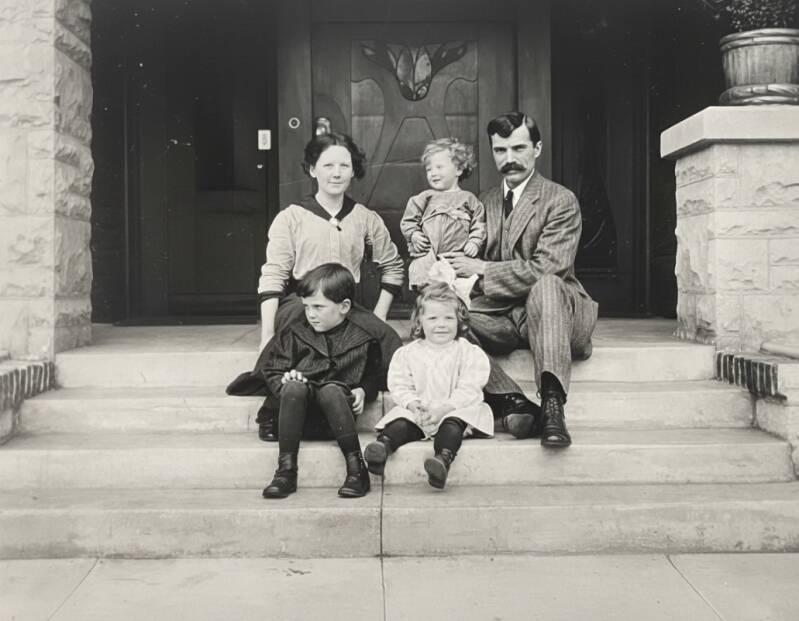

Left: The Traughber family posed on the front steps of their La Brea Avenue home shortly after moving in, with Nora, William, and Frank sitting behind Frank and Margaret. Right: a view of the same location more than 100 years later, offering a striking comparison across time. (Photo courtesy of Tonya Graham McQuade)
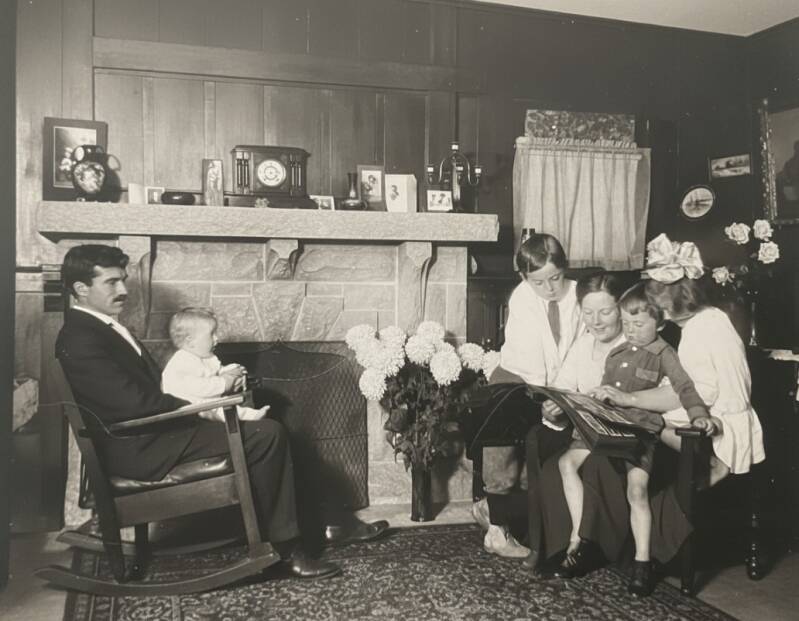
Captured around 1914 within the family home at 1359 North La Brea Avenue, this portrait shows the Traughbers during Hollywood's early years. From left are Dr. William F. Traughber holding son Robert, Frank, Nora Traughber, William, and Margaret. (Photo courtesy of Tonya Graham McQuade)
Dr. Traughber practiced medicine for many years, keeping offices in different parts of Los Angeles and also seeing patients at his home by appointment. A 1912 newspaper ad described him as a physician, surgeon, and osteopath, with office hours downtown and his home address at 1359 La Brea Avenue. At that time, it was common for doctors to mix their work and living spaces. Many of his patients came during Hollywood’s early days, when the area had more doctors, ranchers, and citrus groves than actors. The 1920, 1930, and 1940 federal census records all list him as a physician with a private practice. He was known as a respected member of the community and was involved in local groups like the Rotary Club of Los Angeles.
What happened across the street is especially interesting. In 1917, Charlie Chaplin bought land at the northeast corner of La Brea and De Longpre and began building one of Hollywood’s most famous studios. Suddenly, the Traughber children were growing up right across from one of the world’s most famous people.
The family had a close connection with Chaplin. Margaret Traughber reportedly snuck into the studio with her brothers to play on Chaplin’s tennis courts. Her older brother Frank formed an even stronger bond. In 1973, Frank wrote to Chaplin in Switzerland, recalling his time as an office boy at the studio from 1919 to 1920. He remembered waiting outside Charlie’s dressing room, chatting with Chaplin’s chauffeur, Toraichi Kono, and racing Chaplin’s “Locomobile” down La Brea Avenue. "You won," Frank admitted. His letter brings to mind a time in Old Hollywood before security gates and publicists kept movie stars apart from their neighbors.
Frank had even more memories. At thirteen years old he helped answer Chaplin’s fan mail, signing and sending out about a hundred photos each day. He also sometimes babysat a young Jackie Coogan. Frank was once asked by Chaplin to ride his bicycle in a street scene for the 1919 film A Day’s Pleasure. He earned five dollars a day for a week, which may have been a small part, but for a teenager living next to a movie legend, it must have felt like winning the lottery.
The Traughbers watched Hollywood grow from their front porch. In 1929, La Brea Avenue was widened, taking much of their front yard, including their palm trees. The orange groves disappeared, and businesses moved closer to their property. By 1930, the house was worth $20,000, which was a large sum during the early years of the Great Depression. Despite all the changes, the Traughbers stayed as Hollywood’s movie industry grew around them.
Dr. Traughber retired after many years of practicing medicine. Newspaper reports say he later owned the Traughber Medical Clinic in North Hollywood and spent much of his later life in the San Fernando Valley. He died on July 25, 1947, at his home in Lancaster at age seventy-two. His death certificate lists cerebral hemorrhage as the cause, due to chronic myocarditis and nephritis. He spent forty years in Southern California and was survived by his wife Nora, his daughter, three sons, two brothers, and two sisters. His funeral was held at the Wee Kirk o' the Heather, and he was buried at Forest Lawn Memorial Park.
Today, 1359 North La Brea Avenue looks faded and worn, but it still stands proudly. When Traughber sold the house in March 1944, he called it a "historic La Brea business corner with tremendous speculative possibilities" and offered it for a “sacrifice” of just $12,500. More than eighty years later, it’s clear how accurate that description was. The neighborhood around it has changed completely, but the house remains. Though lonely, it stands as a symbol of Hollywood’s changing history.
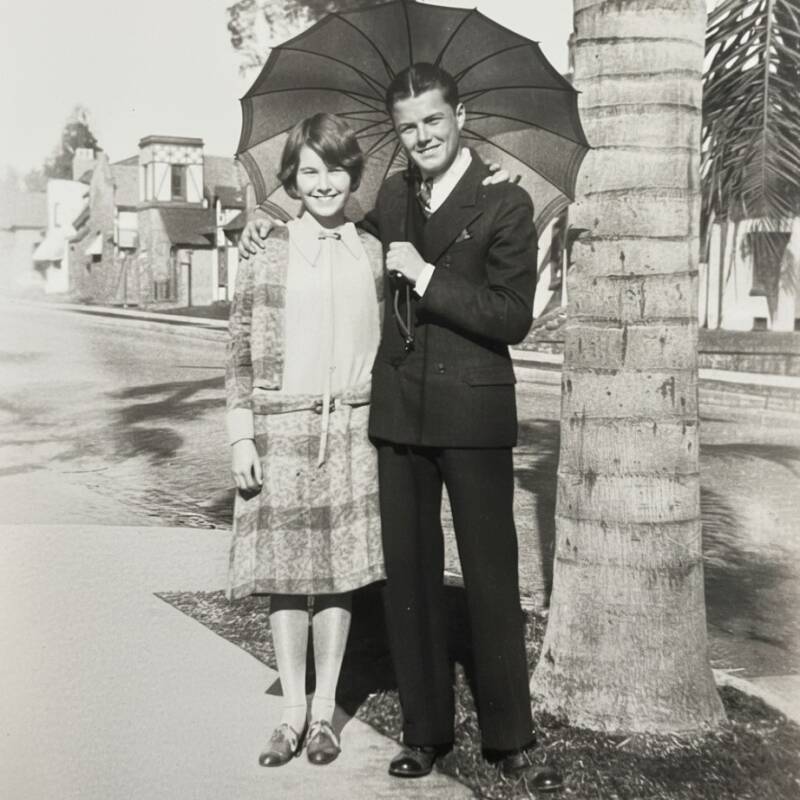
Margaret Traughber and her younger brother William photographed in front of their La Brea Avenue home, with Charlie Chaplin's studio complex visible in the distance. (Photo courtesy of Tonya Graham McQuade.)

Frank Traughber, seen at left riding a bicycle in this scene from Chaplin's 1919 film A Day's Pleasure, supplemented his income by working as an extra for $5 a day while also holding an office boy position at the Chaplin Studios.

The grave of Dr. William Francis Traughber at Forest Lawn Memorial Park in Glendale. Eventide, Lot 3171. (Photo Credit: Kathy Holland, Gates of the Past Genealogy).

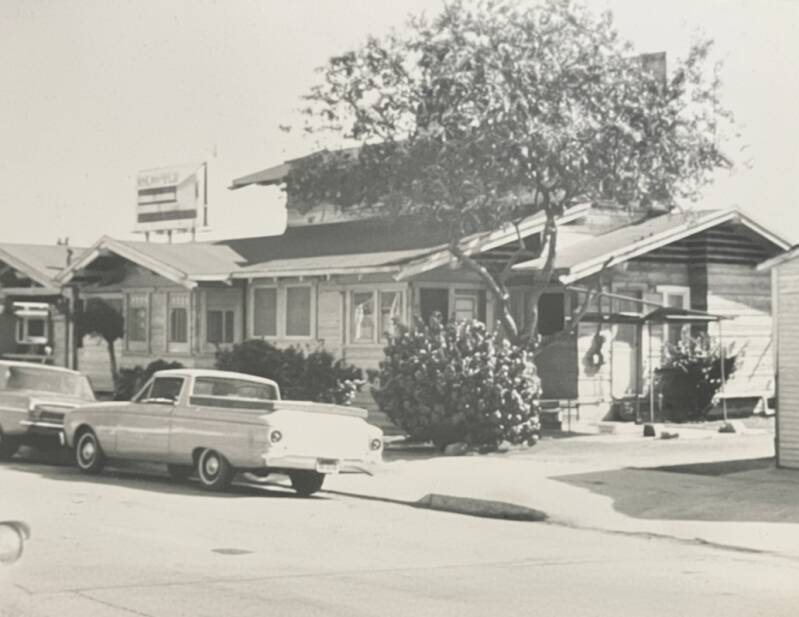
Left: the house and La Brea Court as they appeared when Margaret and her husband returned for a visit in 1967. Right: the property's rear elevation, viewed from De Longpre Avenue. (Photos courtesy of Tonya Graham McQuade)

The house as it appeared in the mid-1980s, with members of the Traughber family standing at right during a return visit to the property. (Photo courtesy of Tonya Graham McQuade)

Many longtime residents may remember when animal hides hung from the fence and luggage was displayed in front of the store for sale.
This history is important for more than just its architecture. The house also represents a lost era in Hollywood, when doctors, teachers, and civic leaders lived alongside the people building the movie industry. Dr. William Francis "Frank" Traughber was not a movie star. He never worked for a studio or saw his name on a theater marquee. But he was there when Hollywood’s most famous neighborhood was built, and he played a part in its history. Dr. Traughber’s story, and the story of 1359 North La Brea Avenue, remind us that Hollywood’s history was shaped not only by stars, but also by the everyday people who watched the city grow from their own front yards.


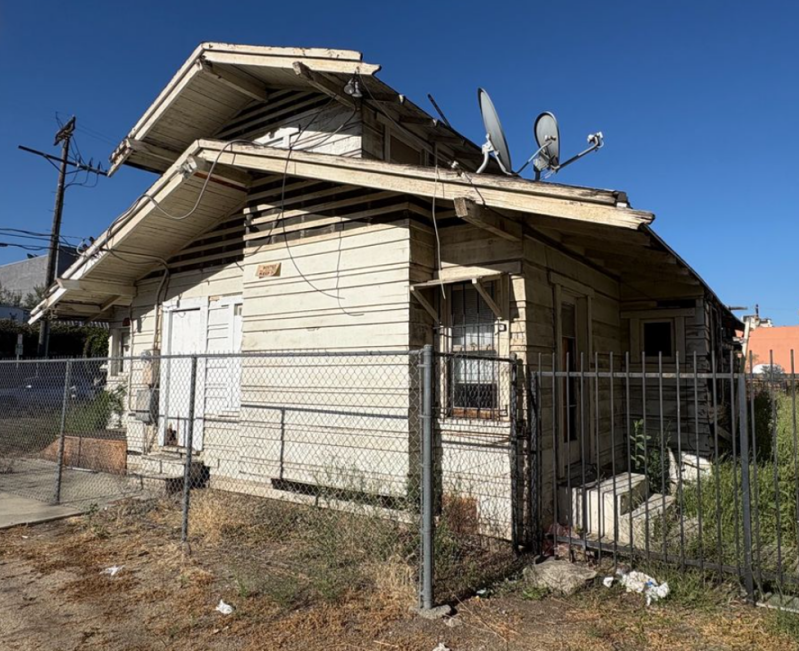

The property in June 2026, a rare survivor that continues to stand 115 years after its construction.
Today, though, the future of the house is uncertain. It has been empty for almost thirty years and has fallen into serious disrepair, with the threat of demolition growing each year. Still, as long as it stands, there is hope to save this piece of old Hollywood. This strong old house has seen Hollywood change from orange groves and dirt roads to a world-famous neighborhood. Losing one of the last pieces of that era to redevelopment would be a real loss. Hopefully, someone with the vision and passion to preserve it will step in and give it new life. The house has survived for over a century; let’s hope it’s not too late to save this priceless part of old Hollywood.
I would like to extend my heartfelt thanks to Tonya Graham McQuade for sharing family photographs, documents, and memories of her great-grandfather, Dr. William F. Traughber, which enriched this article. Her willingness to preserve and share her family's history made it possible to tell a more personal and complete story. I encourage readers interested in the Traughber family and their connection to early Hollywood to visit Tonya's website, where she shares additional family stories and offers several books exploring this remarkable legacy.
Check back tomorrow as I explore the fascinating and often overlooked story of Clark Gable and his first wife, Josephine Dillon—the woman who recognized his potential, transformed his image, and helped launch one of Hollywood's greatest stars.
If you enjoyed this journey through the life of Dr. William F. Traughber and the fascinating history of 1359 North La Brea Avenue, please take a moment to comment on, rate, and share the article to help preserve and celebrate this remarkable piece of Hollywood's past.
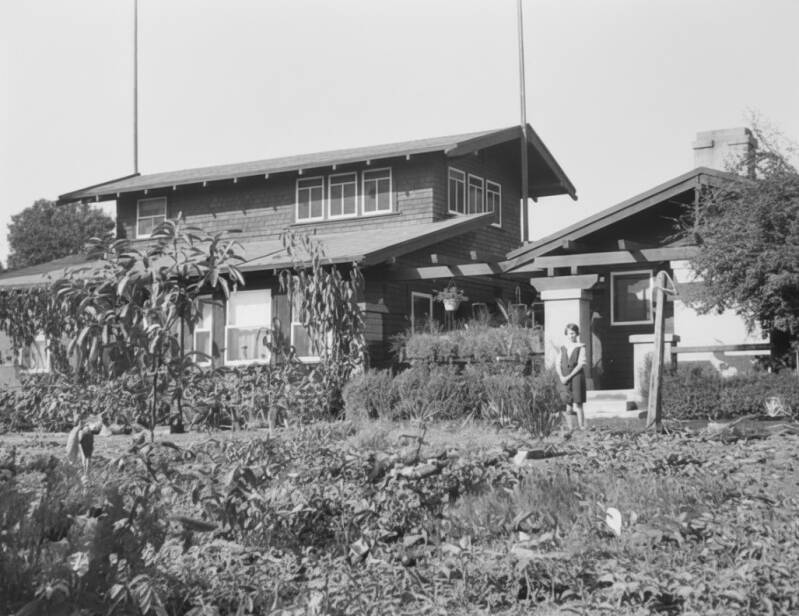
Looking north, this image captures the property before the construction of La Brea Court in 1922, when the adjoining parcel was still an open, undeveloped lot.
Add comment
Comments
To think you've been living so close by -- Actual history of the area -- of La Brea's earlier folks!
What a great story. Thank you for sharing.
Thanks Doug you must have some great memories.
Dr. Traughber and Nora were my grandparents. When a child I lived there temporarily.
Thanks Tonya and I appreciate your help with this article.
Thanks for helping to highlight my family's history and the story of this once beautiful house. I, too, would love to see it preserved. Your article paints some great descriptions of the old neighborhood!